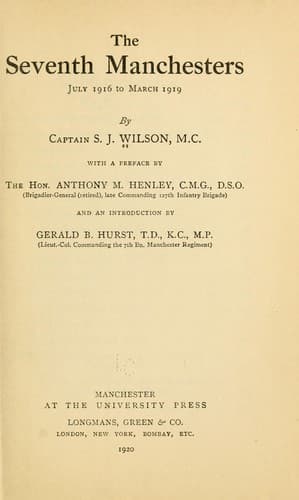
The Seventh Manchesters: July 1916 to March 1919Wilson, S. J.
History
The Seventh Manchesters: July 1916 to March 1919
Wilson, S. J.
Great Britain. Army. Manchester Regiment. Battalion, 7th (Territorial); World War, 1914-1918 -- Regimental histories -- Great Britain
Early morning found us on trek in a steady downpour of rain which made
our already wet clothes more and more sodden. In this doleful fashion we
splashed along over the muddy forest tracks to get close to the East
Lancs. who were carrying out an attack. The 8th Manchesters had a
particularly stern time, encountering nests of machine guns which had
not been cleared from their exposed flanks, so that they lost very
heavily. Nevertheless, the attack was eventually pushed home, and the
Huns were dislodged. Subsequent events revealed that from this moment
the German retirement became a scurry of a disorganised rabble. The
roads were blocked by their hurrying transport, and personnel simply
made the best use of their legs, scampering across country where it was
impossible to march on the roads. The civilians told us that utter
confusion reigned everywhere. Our foremost troops undoubtedly met
determined resistance from the machine gunners, but they were probably
blissfully ignorant of what was taking place behind them.
As far as the 7th was concerned November 6th was one of the most
miserable and trying days ever experienced. In the middle of the morning
we arrived at our position, where we stayed during the whole of the day
in a bitterly cold rain with no possibility of shelter. When it was
ascertained that the enemy had been dislodged we made a few fires and
tried to restore life to our numbed bodies. The divisional commander,
having seen our condition, and realising that very few in the brigade
would be fit for fighting after two such days, ordered up the 125th
brigade, who had had an opportunity of getting dry and warm. We marched
joyfully back in the middle of the night to Le Carnoy and there spent
two days in billets.
The advance of the 42nd was now rapid. Hautmont, a fairly large
manufacturing town, was captured after street fighting, and by the
evening of November 9th an outpost line had been established south-east
of Maubeuge. The 7th meanwhile had marched up through the forest and
were billeted in the small village of Vieux Mesnil. Here we received
official orders to stand fast on the morning of November 11th. At 11
a.m. the battalion paraded outside the church and there the bugles
sounded "Cease fire" for the first and last time during the War. The men
took the news very quietly. We were too close to actual events to give
ourselves over to the mad demonstrations of joy such as took place in
spots more remote. At the same time everyone experienced a curious
feeling of calm satisfaction that an unpleasant task had been
accomplished. The 42nd division had taken part in two great drives, the
clearing of the Turk from British territory in 1916 and the clearing of
the Hun from allied territory in 1918.
CHAPTER XI.
Aftermath and Home.
Public-domain text, read in full here on John Shaqi.
Reviews
Reviews
No reviews yet
Be the first to share your thoughts on this work.
Elsewhere in the archive
Join the Discussion
Join the discussion
Sign in to leave a comment or review.
Sign InorCreate an account