The Seventh Manchesters: July 1916 to March 1919 — John Shaqi
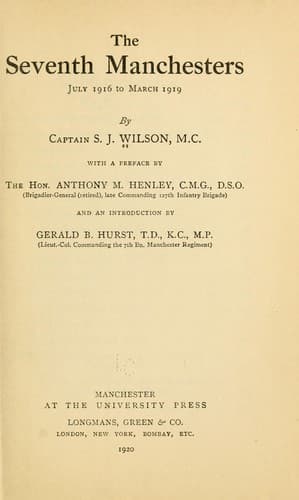
The Seventh Manchesters: July 1916 to March 1919Wilson, S. J.
History
The Seventh Manchesters: July 1916 to March 1919
Wilson, S. J.
Great Britain. Army. Manchester Regiment. Battalion, 7th (Territorial); World War, 1914-1918 -- Regimental histories -- Great Britain
With the 5th on our right we extended into lines about 2,000 yards from
what appeared to be the Turkish position on a ridge to our front. As we
swept into view the enemy opened fire at long range, but very soon it
was evident that they had no stomach left for a further fight. They were
extremely exhausted with their exertions of the previous days,
particularly of the past twenty-four hours, and the sight of lines of
fresh British Infantry moving steadily toward them was more than their
jaded bodies and nerves could stand. As our men climbed the enemy's
ridge white flags began to appear. They were the long white sandbags
carried by every Turk, and very convenient for their purpose. Large
bodies surrendered and they were collected and sent to the rear.
Meanwhile the Colonials had swept round the hill away to the right, and
in a comparatively short space of time about six hundred Turks were seen
being marched back by a few Australian troopers. The enemy's artillery
had ceased fire and were obviously making attempts to escape eastwards,
so with the exception of a few rifle shots from the direction of the 5th
the battle in our sector was over for the day.
This was the death blow to Turkey's and Germany's hopes of ever getting
within striking distance of the Suez Canal, and a vindication of
Kitchener's principle that British soldiers should get out on the desert
to defend the canal, and not allow the canal to defend them. But more
important still, it was the beginning of that forward move so slow and
weary in its early stages, which later developed into General Allenby's
wonderful sweep through Palestine.
Before nightfall "C" and "D" Companies established themselves in support
to the 5th Manchesters, who had now joined up with the Australians on
the left, but there was very little possibility of the Turk attacking
again that day, so all the troops were rested, in preparation for a
strenuous attack on the morrow. Sentry groups were posted, and the
battalion sat down and made a scanty meal of bread accompanied where
possible with a mouthful of water. This was the first meal most men had
had since breakfast. Numbers of prisoners came in during the night,
each of them carrying a full water bottle. The Turk knew how to preserve
a water supply, and what was of greater interest to us, he knew where to
get it. It speaks well, however, for the chivalry of the British soldier
that none deprived their prisoners of their water, although they were
probably almost without themselves. This sporting attitude towards the
enemy, the spirit of "play the game" whether fighting the clean Turk or
the not so reputable German, I never failed to observe throughout the
war.
Public-domain text, read in full here on John Shaqi.
Reviews
Reviews
No reviews yet
Be the first to share your thoughts on this work.
Join the Discussion
Join the discussion
Sign in to leave a comment or review.
Sign InorCreate an account