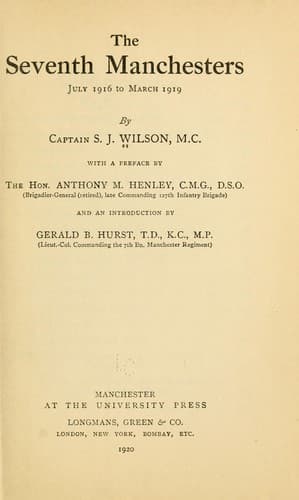
The Seventh Manchesters: July 1916 to March 1919Wilson, S. J.
History
The Seventh Manchesters: July 1916 to March 1919
Wilson, S. J.
Great Britain. Army. Manchester Regiment. Battalion, 7th (Territorial); World War, 1914-1918 -- Regimental histories -- Great Britain
Index 156
Preface.
I first met the 7th Manchesters early in May, 1917, when they were
gaining new experiences of warfare on the Western front, not far from
Epehy in the north of France. They, with the rest of the 127th Infantry
Brigade, and in fact the whole of the 42nd Division had already had a
long war experience in Gallipoli and Egypt, but they had only recently
been transferred to France. I was taking up the command of an Infantry
Brigade for the first time. I did not know then what a lucky man I was,
but it did not take me long to find out, and we worked together without
a break from that time until the armistice.
The writer of this book passes over with considerable sang froid a
certain operation which took place on a June night in 1917. If the 7th
Manchesters, and not only the 7th, but the 5th, 6th and 8th as well will
allow me to say so, I did not enjoy the same complete confidence as to
the result before and during the night in question. The operation
consisted of digging a complete new front line trench, a mile long, on
the whole Brigade Sector, five hundred yards in advance of the existing
front line, and half way across No Man's Land. June nights are short and
it needed practically the whole brigade to get the job done in time. We
had to find not only the diggers, but the covering troops and strong
parties for carrying and wiring. Now four battalions digging on a bare
hillside within point blank range of the enemy's rifles and machine guns
are not well placed to meet attack or even to avoid fire if they are
caught. So everything possible had to be done to avoid raising any
suspicion of what was on foot in the minds of the watchful Germans. The
troops had to work at high pressure and in absolute silence. The R.E.
who were to lay the tapes were the first to go forward after the
covering troops; then came the wire carriers, and, as soon as the R.E.
had had time to get the tapes into position, out went the diggers, who,
after reaching the line, had to be spaced out at working distances along
the whole front. We who stayed behind spent some anxious hours. However
complete the arrangements and however perfectly executed there was yet a
chance that some enterprising and inquisitive German patrol might find
out what was happening in time to give one of their local commanders an
opportunity of hindering our work. We had to make such arrangements as
would give the appearance that we were doing nothing unusual, that we
were in fact excruciatingly normal. There must be neither more noise nor
less than on an ordinary night, and so the artillery and machine guns
must fire their accustomed bursts into the likely places in the German
lines.
Public-domain text, read in full here on John Shaqi.
Reviews
Reviews
No reviews yet
Be the first to share your thoughts on this work.
Join the Discussion
Join the discussion
Sign in to leave a comment or review.
Sign InorCreate an account