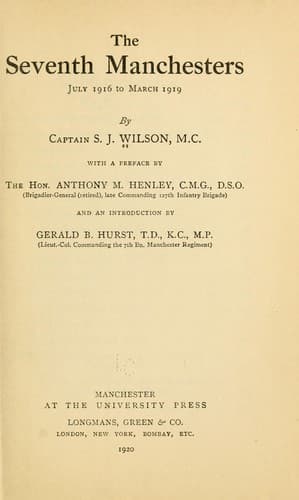
The Seventh Manchesters: July 1916 to March 1919Wilson, S. J.
History
The Seventh Manchesters: July 1916 to March 1919
Wilson, S. J.
Great Britain. Army. Manchester Regiment. Battalion, 7th (Territorial); World War, 1914-1918 -- Regimental histories -- Great Britain
The 42nd Division crossed the Suez Canal for the last time on February
5th, twelve months to the day after the 7th Manchesters had crossed over
to the east side at Shallufa for the first time. The first days march
ended at El Ferdan, very much to the relief of everyone. We had been,
all the way, on a good hard road--a new experience after the life on the
desert--and this brought into play muscles of the leg, not used on the
soft sand. Everyone suffered badly from aching shins and thighs and
very sore feet, so that next day, when the trek was completed to
Ismailia on hot, dusty roads many men fell out, and we were a weary crew
on arrival at Moascar Camp.
Our three weeks' stay here was occupied chiefly in preparing for our new
scene of activities, now definitely known to be France. Eastern kit was
handed in--helmets, shorts and drill tunics--and the battalion seemed to
have been exchanged for a new one dressed in khaki serge and caps. With
our helmets we lost our flashes, or at least the characteristic Fleur de
Lys, but they were replaced by a divisional flash to be worn on the
upper arm of the sleeve of the jacket. This was a diamond in shape, each
Brigade having its own colour, the Manchesters being orange yellow, with
the number of the battalion indicated on it by a red figure. Being close
to Lake Timsa, we frequently indulged in bathing parades under ideal
conditions, for after all Ismailia is really one of the beauty spots of
Egypt. Complimentary farewell parades were held, one on the occasion of
the visit of General Dobell, and the other a march past the C.-in-C, Sir
Archibald Murray, down the Quai Mehemet Ali in the town. Altogether the
7th enjoyed themselves during these days and made the most of the end of
their long sojourn in the East. We were seasoned troops and were well
conversant with the customs of the country. A few pangs of regret at
leaving these things behind can easily be understood, although an
important consideration, and one that weighed heavily with the men, was
the possibility of getting leave from France, a thing unknown in this
place. Hence it was with mixed feelings that the battalion boarded the
train at Ismailia on the evening of March 1st for a rapid journey to
Alexandria. No time was lost here for we detrained on the quay side and
embarked at once.
CHAPTER III.
For France.
Public-domain text, read in full here on John Shaqi.
Reviews
Reviews
No reviews yet
Be the first to share your thoughts on this work.
Join the Discussion
Join the discussion
Sign in to leave a comment or review.
Sign InorCreate an account