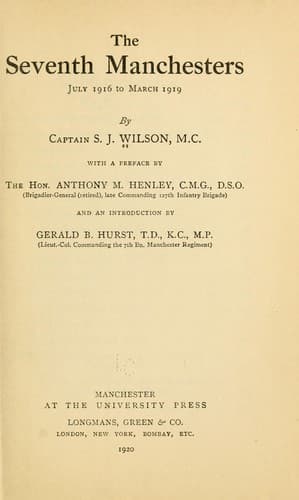
The Seventh Manchesters: July 1916 to March 1919Wilson, S. J.
History
The Seventh Manchesters: July 1916 to March 1919
Wilson, S. J.
Great Britain. Army. Manchester Regiment. Battalion, 7th (Territorial); World War, 1914-1918 -- Regimental histories -- Great Britain
The following morning we arrived at the environs of Paris, and after a
stay at Juvissy continued our journey past Versailles and on through
Amiens to our destination at Pont Remy, a few miles from Abbeville. It
was pitch dark and raining. Imagine the shock to troops straight from
Egypt, where they had left a beautiful dry climate, when they jumped out
of the carriages into four inches of squelching mud. Then we were told
we had to march six or seven miles through the cold rain to our
billeting area at Merelissart. However, we were amongst new surroundings
and new modes of doing things, and conditions were vastly different from
those we had just left, so the sooner we became accustomed to them the
better.
Despite the midnight hour everyone found subject for fun in the French
barns and shippons which were to be our temporary homes. Lt. Hodge and
Lt. Taylor who had worked hard allotting the billets for us joined the
battalion here. Lt. Sievewright had rejoined us at Alexandria on the
boat, he having been invalided to England from Gallipoli. Lt. G. Harris
left to take charge of a Divisional Bombing School, and ended his
service with the battalion, although later he became the Brigade
Intelligence Officer, when we saw a good deal of him again.
After three days the battalion moved back to Liercourt and there the
work of refitting commenced. We had much to learn about organisation and
methods of warfare as practised in France, and vigorous training was
commenced at once.
Major-General Sir W. Douglas left the division, and his successor,
Major-General Mitford, lost no time in getting us ready for the line.
Just at this time, and whilst Col. Cronshaw and other officers and
N.C.O's. were up in the line for instruction, the German retirement on
the Somme and the Ancre to the Hindenburg line took place. As soon as
brigades were fitted out they lost no time in moving forward into the
war zone, commencing with the Lancs. Fusiliers. At the end of March the
127th brigade entrained for Chuignes and from there the 7th marched
forward to Dompierre, which had been the scene of such heavy fighting
by the French in 1916. We thus got our first impressions of the
devastated area of France, and I am sure there was not a mind in the
battalion into which these impressions did not sink deep. The misery of
it was by no means diminished when we arrived at our destination, for
accommodation had to be found amidst impossible ruins and in the
scattered half-destroyed dug-outs amongst the trenches which
criss-crossed the village. All this had to be done in pouring rain. When
at last we settled down it was found that our new homes were also shared
by huge rats who capered about in a most homely manner.
Public-domain text, read in full here on John Shaqi.
Reviews
Reviews
No reviews yet
Be the first to share your thoughts on this work.
Join the Discussion
Join the discussion
Sign in to leave a comment or review.
Sign InorCreate an account