The Seventh Manchesters: July 1916 to March 1919 — John Shaqi
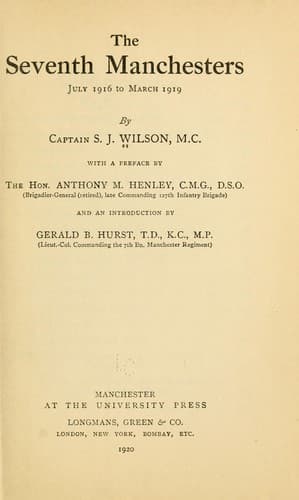
The Seventh Manchesters: July 1916 to March 1919Wilson, S. J.
History
The Seventh Manchesters: July 1916 to March 1919
Wilson, S. J.
Great Britain. Army. Manchester Regiment. Battalion, 7th (Territorial); World War, 1914-1918 -- Regimental histories -- Great Britain
Captain Wilson's book continues the story of the 7th (1st 7th)
Manchesters, which is recorded in my own book "With Manchesters in the
East," from July, 1916 until November, 1918. It is written with intimate
knowledge and much understanding, and will be enjoyed by all his
comrades. It was the good fortune of the Manchester Territorials (127th
Brigade) to belong to the first Territorial Division (the 42nd), that
ever left these islands for active service, and this active service
eventually took place on three fronts. The 7th Battalion garrisoned the
Sudan and fought through the Gallipoli campaign. It recruited its
strength at Suez, and then helped to clear the Sinai Peninsula of the
Turks. Finally it served for two and a half years in Flanders. It
translated its motto, "We never sleep" into its daily life.
This volume will be a useful supplement to any general history of the
War. It is based on the diary of a Regimental Officer, who won
considerable distinction in the field, and whose eyes missed little of
consequence. It is of even more value as evidence of what men of
essentially civilian habits and traditions can achieve as soldiers. The
numbers of the 7th Manchesters were never fully up to strength after
April, 1915, and for many months at a time while in the East they fell
to vanishing point. Yet from the day in September, 1914, when the
original first-line Battalion sailed from Southampton for Port Sudan in
the "Grantully Castle," each successive draft was of the same mould. The
men came from the same neighbourhood, were of the same capacity, and had
been bred with the same ideas. Their devotion was founded on a sense of
duty. They were personally utterly remote from what is called
militarism, and saw little fascination in its pomp. The survivors are
now absorbed once more in the undramatic industry of Lancashire. There
is nothing to indicate to an observer that they have ever left it. The
last time you saw your tramway conductor may have been as a bomber in
"the western birdcage" on Cape Helles; your fellow passenger may have
last talked to you as your "runner," when you tramped along the
duckboards from Windy Corner to Givenchy. What such men did for England
will therefore illustrate for all time the potentialities of a
Territorial Force.
Captain Wilson's style of expression and cast of thought are, in my
view, true to type. He is the Lancashire man of action, who affects no
literary arts. These pages are bare of heroics. There is a soldierly
brevity in his account of even of the bravest exploit. There is also
plenty of quiet humour. The reader will search vainly for any "villain
of the piece." The "Hun" is to Captain Wilson, as to the normal British
officer, just a "Boche" and no more; to the rank and file he was simply
"Jerry." If you want adjectives, you will have to look for them in _John
Bull_ or listen to speeches in the House of Commons.
Public-domain text, read in full here on John Shaqi.
Reviews
Reviews
No reviews yet
Be the first to share your thoughts on this work.
Join the Discussion
Join the discussion
Sign in to leave a comment or review.
Sign InorCreate an account