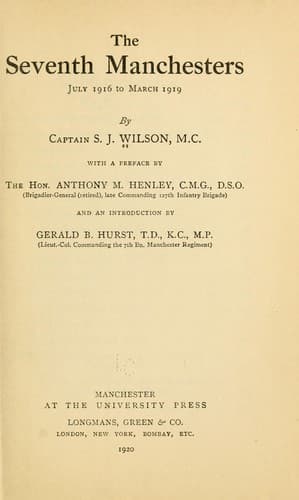
The Seventh Manchesters: July 1916 to March 1919Wilson, S. J.
History
The Seventh Manchesters: July 1916 to March 1919
Wilson, S. J.
Great Britain. Army. Manchester Regiment. Battalion, 7th (Territorial); World War, 1914-1918 -- Regimental histories -- Great Britain
On the whole, we look back to the weeks at Achiet as a period of solid
training, plenty of "Spit and Polish," but "lots of fun." On the 1st of
August we got word of the big offensive at Ypres amidst all that
disastrous rain, and we expected to move up there any day. It was not
until three weeks later, however, that we did move, and then it was
known definitely that we were for Flanders. The battalion marched down
to Aveluy, near Albert, on an enervatingly hot day and remained one
night in huts there. The next night they entrained and proceeded to
Poperinghe in Belgium, and so added another country to the list of those
they visited during the war.
CHAPTER V.
Belgium.
YPRES.
Ypres! That wonderful place, the sound of whose name makes the heart of
the Englishman at home glow with pride, but makes the soldier, friend or
foe, shudder at the mere recollection. It was the scene of much stern
work, and if Belgium has been dubbed the Cockpit of Europe, surely the
"Salient" was the cockpit of cockpits. More men lie buried in that small
patch of ground than one cares to think about, and when instances of the
unreasonableness and veritable folly of war are cited from other fronts,
they can always be equalled by experiences at Ypres.
In many respects, however, the 7th were lucky in this sector, for we did
not actually go over the top during our stay. Other units of the
division carried out what would be termed minor operations (which are
anything but minor operations to the people concerned), but the 7th
escaped any such work. So far as we were concerned it was a continuation
of line-holding, but under vastly new conditions. It would be useful,
perhaps, to indicate the nature of these conditions.
As all the world knows the third battle of Ypres commenced on the 31st
July, 1917, preceded by a terrific concentrated bombardment of the Hun
positions lasting about ten days. The effect of this bombardment was to
obliterate all signs of life on that part of the earth, with the
exception of a few horrible, naked, and shattered trees. Nothing green
was visible anywhere. In fact the land looked as though it had been a
very choppy earth-brown sea suddenly frozen to stillness. Everywhere
was shell-holes, shell-holes, shell-holes--large and small. Only by
careful searching could one ascertain where enemy trenches had been.
Dotted about over this terrain were the Hun "pill-boxes," concrete
shelters in which the enemy had made their last machine gun fight.
Whereas at one time they had been skilfully concealed from view, they
were now standing stark above the ground which had been torn away from
them. Some of the pill-boxes, indeed, had been smashed in by direct hits
from the heavies, so deadly had been our gun fire during those ten days.
Public-domain text, read in full here on John Shaqi.
Reviews
Reviews
No reviews yet
Be the first to share your thoughts on this work.
Join the Discussion
Join the discussion
Sign in to leave a comment or review.
Sign InorCreate an account