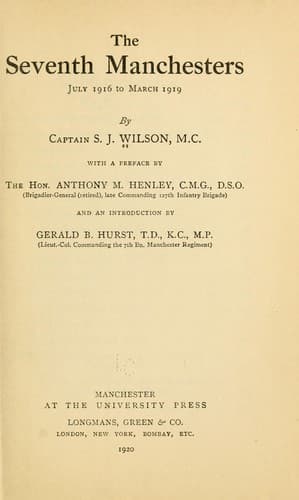
The Seventh Manchesters: July 1916 to March 1919Wilson, S. J.
History
The Seventh Manchesters: July 1916 to March 1919
Wilson, S. J.
Great Britain. Army. Manchester Regiment. Battalion, 7th (Territorial); World War, 1914-1918 -- Regimental histories -- Great Britain
At dawn on April 5th the Hun commenced to send over thousands of gas
shells in the direction of Essarts. It was a dull, misty
morning--perfect conditions for this form of devilry--and we could hear
the brutes whistling and whining over our heads for more than three
hours. The intention was, of course, to silence our guns, and the object
of this was to make an attack upon Bucquoy all the easier. He came over
at the L.F's. and there was heavy fighting all the morning, but he did
not progress much. The 8th L.F's. suffered severely, losing all their
officers, including Lt.-Col. Davies (previously of the 6th Manchesters),
who was killed. The enemy's intention had been to take the village and
push on with a view to straightening the line, but he only captured the
eastern portion of the village, and that only after very heavy losses.
Similar progress had previously been made against the division on the
right, and this made the L.F. situation impossible. We afterwards learnt
that a large number of gas casualties had gone down from the Essarts
district. In their solicitude during the bitterest days the division had
called upon the battle surplus of each unit, and had made a composite
battalion of them to act in reserve amongst the trenches N.E. of
Gommecourt. These people, as well as the gunners, came in for the gas
shelling, and it was very disappointing to hear of our own men, like
C.S.M. Shields, Sgt. Tabbron, etc., who had been left behind as battle
surplus, going down gassed. Fortunately, most of them rejoined the
battalion later. During this day's fighting some L.F's. were staggered
to find an old French woman in a cellar in Bucquoy, and they had the
utmost difficulty in persuading her to leave her "home." That was her
abode and she was prepared to live in it whatever the conditions.
The next few days resulted in a complete victory for mud. Rain
continued, and work as we would the conditions could not be conquered.
Men stood in it, and when they could, slept in it. To move about meant
wading through it, in places up to the thighs, and this was steadily
wearing out the last flicker of humanity and grit in our men. Casualties
were also increasing. Lieut. Bateman was wounded in Essarts whilst on
his way back to the battalion from a Course, and in "B" company 2nd-Lt.
Woodworth was hit. Eventually we relieved the 5th in the front line near
Ablainzevelle, where we found the trenches in an even worse condition,
if that were possible. Real joy possessed our souls, although it is
doubtful whether at the time we were capable of appreciating it, when
the news was definite that the division was to go right out for a rest.
On the night of April 7th, the 2nd 7th West Ridings (62nd division) came
up and relieved us, and the Fleur de Lys set their faces joyfully to the
west and marched off in good spirits, although with exhausted bodies,
conscious of having done their duty in stopping the mad rush of the
Huns.
CHAPTER VIII.
Worrying the Hun.
Public-domain text, read in full here on John Shaqi.
Reviews
Reviews
No reviews yet
Be the first to share your thoughts on this work.
Elsewhere in the archive
Join the Discussion
Join the discussion
Sign in to leave a comment or review.
Sign InorCreate an account