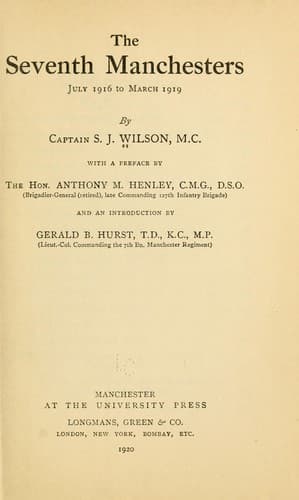
The Seventh Manchesters: July 1916 to March 1919Wilson, S. J.
History
The Seventh Manchesters: July 1916 to March 1919
Wilson, S. J.
Great Britain. Army. Manchester Regiment. Battalion, 7th (Territorial); World War, 1914-1918 -- Regimental histories -- Great Britain
Never since the weary entry into Katia did the 7th Manchesters present
such a sorry appearance as they did when they straggled into Soustre in
the grey hours of April 8th. It was an effort to drag one leg in front
of another, and our feet were sodden and painful. Almost every particle
of clothing and equipment was smothered with red, clayey mud, and thin,
tired faces were covered with a many days' growth of beard. Here we
struggled into a row of lorries and were carried off to Vauchelles to be
housed in huts vacated by some army school. After a good meal and a
sleep we were roused in the middle of the afternoon to be told that
another move had to be accomplished. With imprecations on the staff and
all its works we fell in and marched off to Louvencourt to occupy
billets, and were at last assured that we had settled for a rest.
The next few days we spent in recuperation and cleaning up. The rapidity
with which the men recovered their smart appearance was one of the
striking features of the war, and indicated the wonderful desire for
fitness that the Britisher had acquired in his soldiering days. Col
Bromfield, however, had not been able to withstand the strain, and to
the regret of everyone departed to hospital with pleurisy, a
circumstance made all the more depressing when we learnt that his return
was highly improbable. A more popular C.O. never commanded the 7th, and
we were always proud of his high opinion of us. In his dealings with all
ranks, from the second in command to the lowest private, he had ever
proved himself a perfect gentleman, while his control of matters during
the most anxious times inspired an unswerving confidence. As a gallant
leader and commander his name stands high in the records of the
battalion.
It was by no means certain that the enemy would not open out with
another onslaught on this front, for he was making desperate efforts to
reach Amiens further south, and a break through here would make his task
much easier. With the assistance of Chinese labour lines of trenches had
been dug, and they were speedily wired in by batches of Royal Engineers
and Labour Corps. The first system to be defended if the front line
collapsed was called the Purple Line. Behind that was the Red Line,
while further back still was the Brown Line, protecting Doullens. It was
here during these troubled days that the historic meeting took place
between Sir Douglas Haig and Marshal Foch, when the latter took over
supreme command. As well as regaining lost energy the 42nd division had
to be responsible for a portion of the Red Line in the event of a break
through, so at various times parties of officers and N.C.O's. made trips
to it for reconnaisance purposes, and schemes were evolved for the
possible disposition of companies and the siting of L.G. posts, etc.,
under the leadership of Major Higham, now commanding the battalion.
Public-domain text, read in full here on John Shaqi.
Reviews
Reviews
No reviews yet
Be the first to share your thoughts on this work.
Elsewhere in the archive
Join the Discussion
Join the discussion
Sign in to leave a comment or review.
Sign InorCreate an account