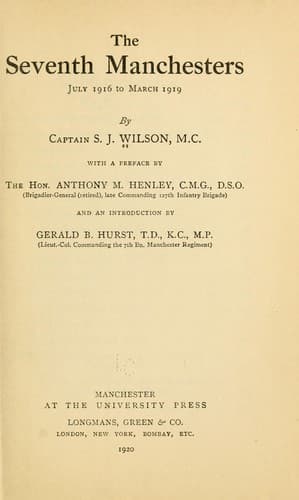
The Seventh Manchesters: July 1916 to March 1919Wilson, S. J.
History
The Seventh Manchesters: July 1916 to March 1919
Wilson, S. J.
Great Britain. Army. Manchester Regiment. Battalion, 7th (Territorial); World War, 1914-1918 -- Regimental histories -- Great Britain
music being regularly thundered out by the crash, crash, of heavy
howitzers.
East of our ridge, and parallel to it, was a long gentle valley. In the
old days the Germans had been content to build their trenches half-way
up the eastern slope, and the French had faced them on the opposite
side, but now the Huns in the foolish arrogance of their hearts must
needs swarm over the whole valley, and offer themselves and their works
as targets for our searching gun-fire. On the summit of their ridge and
due east of Hebuterne is Puisieux-au-Mont, in almost the same condition
of devastation as Gommecourt, while further beyond, the trees of Achiet
can be seen. During the summer months those who wished could reckon up
the times of arrival and departure of trains at the German railhead at
Achiet, for the smoke from the engines could be distinctly observed.
Night after night our planes droned heavily over to the accompaniment of
wonderful displays of "flaming onions," parachute flares, searchlights,
and anti-aircraft gun-fire, and bombed these back areas with
demoralising effect. Further along the enemy ridge to the right, and
closer in, was what the trench maps grimly described as "Serre (site
of)." If you want testimony of the complete destructive power of British
shell-fire, go to Serre. The roads round about were marked on these
maps, but ironically labelled "Damaged by shell-fire." I think the word
"obliterated," openly admitted in the case of one or two, would have
applied to all. In other words the whole terrain bore the traces of the
thunderous days of 1916, and nothing of value was left standing. Thus,
when keen observers set their maps and scanned the low ground for Mark
Copse, Luke Copse, Touvent Farm, Observation Wood, or Red Cottage, there
was nothing visible. It was all a myth. Further south the masses of
white chalk thrown up by the historic crater at Beaumont Hamel were
useful for they served as a landmark and helped to locate other points
of interest.
Compared with the enemy we were in a relatively happy position. The
ridge which contained the front line shielded all the immediate back
area from direct observation, so that even the garrisons of the support
trenches could wander about in the open, while if there was "nothing
doing," the men back in reserve could lie out in the long grass and bask
in the sunshine. This was all very comforting and relieved the strain of
war very considerably, but the advantages in the matter of organisation
were illimitable. Rations came up in the middle of the day, and the
limbers and water carts, in singles of course on account of balloon
observation, trundled up the road in the afternoon to a point within
four hundred yards of the front line! As the men put it "We were
laughing"--especially when the enemy once or twice attempted a relief
before darkness over their exposed ground, and were severely knocked
about for their pains.
Public-domain text, read in full here on John Shaqi.
Reviews
Reviews
No reviews yet
Be the first to share your thoughts on this work.
Elsewhere in the archive
Join the Discussion
Join the discussion
Sign in to leave a comment or review.
Sign InorCreate an account