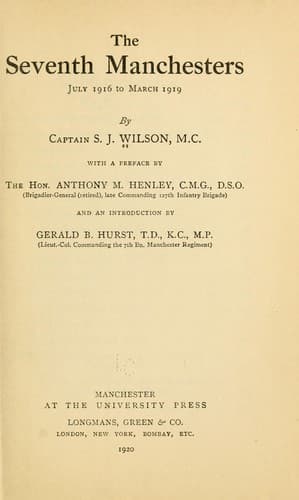
The Seventh Manchesters: July 1916 to March 1919Wilson, S. J.
History
The Seventh Manchesters: July 1916 to March 1919
Wilson, S. J.
Great Britain. Army. Manchester Regiment. Battalion, 7th (Territorial); World War, 1914-1918 -- Regimental histories -- Great Britain
But to return to Hebuterne and the days of our first acquaintance with
it. Many people were convinced that the Hun would attack again, and our
higher command had found support for this gloomy prospect amongst their
archives, so that we were enjoined to remain on the strictest qui vive.
The first day's work consisted in re-organisation of the line, based
upon the principle of defence "in depth." This meant that a battalion,
for instance, did not expose the whole of its personnel in the front
line to be obliterated in the first shock of attack, but they must be
disposed in the best tactical positions, with a slight garrison in front
and the remainder ranged along behind. Speaking very generally a unit
was made responsible for the defence of an area, and the principle of
defence was to hold it, not by successive lines of defence, but by a
series of mutually supporting posts arranged chequerwise and in depth.
This arrangement was intended to break up the enemy's attack formation,
to stop parts of it and to allow other parts to advance, but to advance
only in such places as would make them most vulnerable to
counter-attack. This principle applied also down to the company and even
the platoon. It is easily seen that a good deal of organisation was
demanded from the battalion commander, while the smallest unit
commander, perhaps a lance-corporal, was left with much responsibility.
In view of the possibly impending attack, Hebuterne was hurriedly put
into a sound state of defence by the untiring energy of Gen. Henley and
his subordinates. Whilst all this was going on our patrolling was
excessively active, and every night No Man's Land fell into our hands
right up to the enemy posts. If possible we were to "Snaffle a Hun" with
a view to identification and information about the supposed attack, and
when it was discovered that the Boche was too alert in spite of
persistent small attempts by the Manchesters and the L.F's. this was
regarded as good proof by the attack theorists. However, nothing
materialised beyond the steady arrival of Boche shells of all calibres,
and we were not sorry.
Public-domain text, read in full here on John Shaqi.
Reviews
Reviews
No reviews yet
Be the first to share your thoughts on this work.
Elsewhere in the archive
Join the Discussion
Join the discussion
Sign in to leave a comment or review.
Sign InorCreate an account