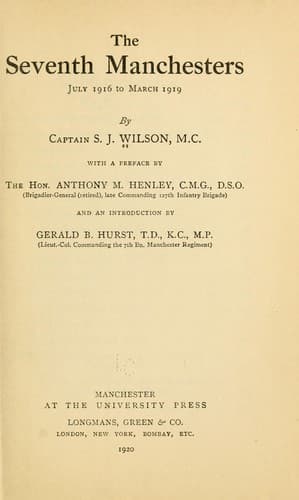
The Seventh Manchesters: July 1916 to March 1919Wilson, S. J.
History
The Seventh Manchesters: July 1916 to March 1919
Wilson, S. J.
Great Britain. Army. Manchester Regiment. Battalion, 7th (Territorial); World War, 1914-1918 -- Regimental histories -- Great Britain
The 127th brigade were given camp areas around Henu, divisional
headquarters being at Pas. We made the most of these May weeks, filled
with delightful sunshine, and, as events worked out, it was as well we
did, for it was the last long rest period we were to get until after the
armistice. Important changes took place in the battalion about this
time. Major Higham and Capt. Townson, both pre-war officers of the 7th,
severed their active service connection with us by being invalided to
England, the former's place being taken by Major Rae of the Liverpool
Scottish. Amongst a draft of officers that we received from a division
that had been broken on the fifth army front was Capt. Allen, M.C.,
whose original unit was the 6th Manchesters. He was put in command of
"A" company. R.S.M. Anlezark, of the 1st battalion, was posted to us for
duty, and A/R.S.M. Clough succeeded R.Q.M.S. Ogden, who had returned to
England after a long period of hard and useful work with the 7th. It was
not many weeks after this period of rest that another long-standing and
popular officer was lost to the 7th; this was Capt. Nidd, M.C. We had
always known that his grit and determination exceeded his physical
capacity, but his splendid sense of duty led him to ignore this fact,
although it was common knowledge that had he so wished he could have
been invalided out of the army long before. After severe trials on
Gallipoli, a campaign he went through from June to the evacuation (he
was one of the very few men to whom that evacuation was irksome), he had
had a relapse in hospital in Egypt for some weeks. The Bucquoy fight,
however, had proved too much for him, and he never really recovered from
the ill-effects of it. This was accentuated by the death of two of his
near and dear friends--Lt. W. Thorp for whom, as one of his subalterns,
he had a particular esteem, and Capt. Tinker. The latter was a pre-war
officer of the 7th, while Thorp had gone out to the Sudan in the ranks,
served through Gallipoli with distinction (vide Major Hurst's book) and
then received a commission early in 1916. Capt. Tinker's record with the
battalion was one of steady confidence. After being invalided to England
from a wound received on Gallipoli, he rejoined in Egypt in Feb. 1916,
and was immediately given command of "A" company. From that day he had
always been amongst us, and, except when on leave or on a course, he was
with his company, in the line or out of it. In fact, it was a record of
"full steam ahead" until the day he was killed amongst his men. What
Tinker was to "A" so was Nidd to "B" company, and his greatest regret,
when at last hospital claimed him, was in leaving the men whom he knew
so well. His departure was followed by a long illness, and it was a
great blow to his friends to hear of his death after the armistice in
his own home at Cheadle Hulme. His name can be added to the long list of
victims of the great German offensive in March.
Public-domain text, read in full here on John Shaqi.
Reviews
Reviews
No reviews yet
Be the first to share your thoughts on this work.
Elsewhere in the archive
Join the Discussion
Join the discussion
Sign in to leave a comment or review.
Sign InorCreate an account