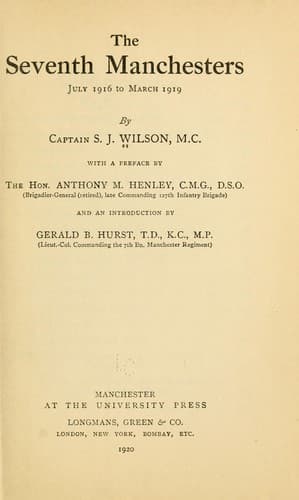
The Seventh Manchesters: July 1916 to March 1919Wilson, S. J.
History
The Seventh Manchesters: July 1916 to March 1919
Wilson, S. J.
Great Britain. Army. Manchester Regiment. Battalion, 7th (Territorial); World War, 1914-1918 -- Regimental histories -- Great Britain
Strict training was indulged in during these weeks, and in addition hot,
laborious days were occupied by rehearsals of the manning of the Red
Line in the neighbourhood of Souastre, to say nothing of skeleton
counter-attacks upon Beer Trench, Rum Trench, and Stout Trench, near
Gommecourt. We never knew the point of these names unless they were to
act as a stimulant to the vigour of our thrusts, the troops labouring
under the delusion that the trenches were filled with the liquids
indicated. At all events they were not there during the rehearsals in
spite of the hot weather. But if these diversions caused us to attain
the boiling point of excitement, the arrival of General Byng on May 21st
to witness a special stunt by the 7th almost burst the thermometer. A
source of some interest was the presence of an American battalion
consisting of raw troops of three weeks' New York training, to which the
127th brigade was acting as godfather. They worked diligently and with a
keen appreciation of any hints supplied to them by their British
friends. Also, not to be outdone by our frequent displays of football,
they regularly utilised our ground for baseball, of which game they
possessed a few brilliant exponents. We soon grew to like our new
allies, and we were rather sorry when they departed to join their own
division.
On June 6th the 42nd division took over the line once more and were not
relieved of responsibility of the front until Sept. 6th, sixteen days
after the big offensive had commenced. The 7th occupied the part of the
front which we knew so well at Hebuterne, relieving a battalion of the
New Zealand Division. The "Diggers" had worked hard upon these trenches
with the result that they were now in excellent condition. A good spell
of weather also assisted in the comfort of the troops. Col. Manger's
policy was to give the Hun no rest, and he began to put his principles
into practice at Hebuterne. As soon as we arrived, a thorough
reconnaissance of the enemy positions was made, and we began to make
preparation for a raid of some magnitude. This was carried out by "B"
company, of which Capt. Grey Burn was now in command, and the officers
selected to go over with the raiders were Lieut. Wender, D.C.M., who had
previously served with the 1st Battalion in Mesopotamia, 2nd-Lt. Milne
and 2nd-Lt. Goodier. Goodier had been a sergeant in "C" company, and for
his excellent services at Bucquoy had been recommended for promotion in
the field to the commissioned ranks, a distinction which came through
while we were at Henu.
Public-domain text, read in full here on John Shaqi.
Reviews
Reviews
No reviews yet
Be the first to share your thoughts on this work.
Elsewhere in the archive
Join the Discussion
Join the discussion
Sign in to leave a comment or review.
Sign InorCreate an account