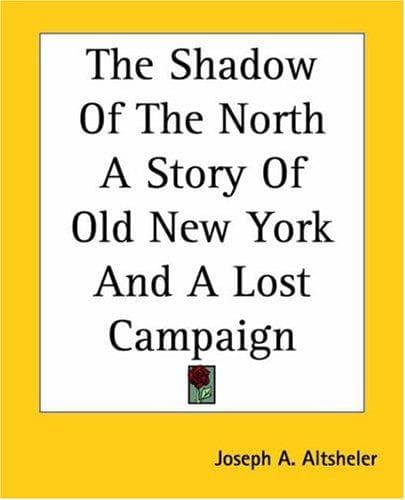
The Shadow of the North: A Story of Old New York and a Lost Campaign — John Shaqi
The Shadow of the North: A Story of Old New York and a Lost CampaignAltsheler, Joseph A. (Joseph Alexander)
History
The Shadow of the North: A Story of Old New York and a Lost Campaign
Altsheler, Joseph A. (Joseph Alexander)
United States -- History -- French and Indian War, 1754-1763 -- Juvenile fiction
Robert now had much experience of Indian attack and forest warfare,
but it always made a tremendous impression upon his vivid and uncommon
imagination. The great pulses in his throat and temples leaped, and
his ear became so keen that he seemed to himself to hear the fall of
the leaf in the forest. It was this acute sharpening of the senses,
the painting of pictures before him, that gave him the gift of golden
speech that the Indians had first noticed in him. He saw and heard
much that others could neither hear nor see, and the words to describe
it were always ready to pour forth.
Willet and Tayoga were crouched near him, their rifles thrust forward
a little, and just beyond them was Captain Colden who had drawn a
small sword, more as an evidence of command than as a weapon. The
men, city bred, were silent, but the faces of some of them still
expressed amazement and incredulity. Robert's quick and powerful
imagination instantly projected itself into their minds, and he saw as
they saw. To them the cry of a wolf was the cry of a real wolf, the
forest was dark, lonely and uncomfortable, but it was empty of any
foe, and the four who had come to them were merely trying to create a
sense of their own importance. They began to move restlessly, and it
required Captain Colden's whispered but sharp command to still them
again.
The cry of the wolf, used much by both the Indians and the borderers
as a signal, came now from the east, and after the lapse of a minute
it was repeated from the west. Call and answer were a relief to
Robert, whose faculties were attuned to such a high degree that any
relief to the strain, though it brought the certainty of attack, was
welcome.
"You're sure those cries were made by our enemies?" said young Colden.
"Beyond a doubt," replied Willet. "I can tell the difference between
the note and that of a genuine wolf, but then I've spent many years in
the wilderness, and I had to learn these things in order to live.
They'll send forward scouts, and they'll expect to find you and your
men around the fire, most of you asleep. When they miss you there
they'll try to locate you, and they'll soon trail us to these bushes."
Captain James Colden had his share of pride, and much faith in
himself, but he had nobility of soul, too.
"I believe you implicitly, Mr. Willet," he said. "If it had not been
for you and your friends the enemy would have been upon us when we
expected him not at all, and 'tis most likely that all of us would
have been killed and scalped. So, I thank you now, lest I fall in the
battle, and it be too late then to express my gratitude."
It was a little bit formal, and a little bit youthful, but Willet
accepted the words in the fine spirit in which they were uttered.
Public-domain text, read in full here on John Shaqi.
Reviews
Reviews
No reviews yet
Be the first to share your thoughts on this work.
Join the Discussion
Join the discussion
Sign in to leave a comment or review.
Sign InorCreate an account