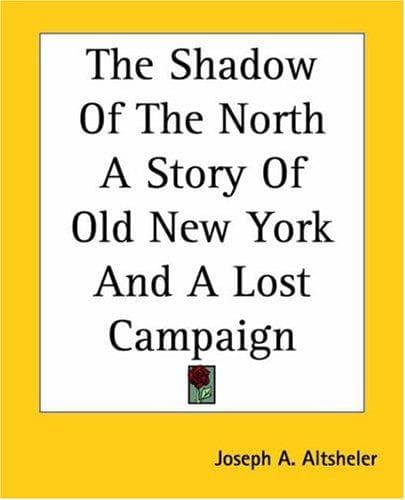
The Shadow of the North: A Story of Old New York and a Lost CampaignAltsheler, Joseph A. (Joseph Alexander)
History
The Shadow of the North: A Story of Old New York and a Lost Campaign
Altsheler, Joseph A. (Joseph Alexander)
United States -- History -- French and Indian War, 1754-1763 -- Juvenile fiction
The west was now blazing with terraces of red and yellow, rising above
one another, and the east was misty, gray and dim. Twilight was not
far away. The thread of smoke that had lain against the sky above the
forest was gone, the glittering bar of red and gold being absolutely
free from any trace. St. Luc's force opened fire again, bullets
clipping twigs and leaves, but the defense lay quiet, except Black
Rifle, who crept back and forth, continually seeking a target, and
pulling the trigger whenever he found it.
The misty gray in the east turned to darkness, in the west the sun
went down the slope of the world, and the brilliant terraces of color
began to fade. The firing ceased and another tense period of quiet,
hard, to endure, came. At the suggestion of the hunter Colden drew in
his whole troop near the cliff and waited, all, despite their
weariness and strain, keeping the keenest watch they could.
But Robert, instead of looking toward the east, where St. Luc's force
was, invariably looked into the sunset, because it was there that
Tayoga had gone, and it was there that they had seen the smoke, of
which they expected so much. The terraces of color, already grown dim,
were now fading fast. At the top they were gone altogether, and they
only lingered low down. But on the forest the red light yet blazed.
Every twig and leaf seemed to stand individual and distinct, black
against a scarlet shield. But it was for merely a few minutes. Then
all the red glow disappeared, like a great light going out suddenly,
and the western forest as well as the eastern, lay in a gray gloom.
It always seemed to Robert that the last going of the sunset that day
was like a signal, because, when the night swept down, black and
complete everywhere, there was a burst of heavy firing from the south
and a long exultant yell. No bullet sped through the thickets, where
the defenders lay, and Willet cried:
"Tayoga! Tayoga and help! Ah, here they come! The Mohawks!"
Tayoga, panting from exertion, sprang into the bushes among them, and
he was followed by a tall figure in war paint, lofty plumes waving
from his war bonnet. Behind him came many warriors, and others were
already on the flanks, spreading out like a fan, filing rapidly and
shouting the war whoop. Robert recognized at once the great figure
that stood before them. It was Daganoweda, the young Mohawk chief of
his earlier acquaintance, whom he had met both on the war path and at
the great council of the fifty sachems in the vale of Onondaga. Had
his been the right to choose the man who was to come to their aid, the
Mohawk would have been his first choice. Robert knew his intense
hatred of the French and their red allies, and he also knew his fierce
courage and great ability in battle.
Public-domain text, read in full here on John Shaqi.
Reviews
Reviews
No reviews yet
Be the first to share your thoughts on this work.
Join the Discussion
Join the discussion
Sign in to leave a comment or review.
Sign InorCreate an account