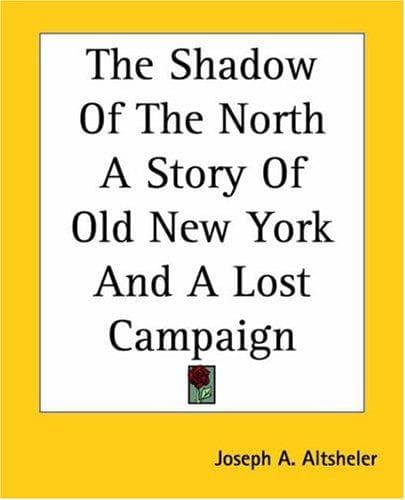
The Shadow of the North: A Story of Old New York and a Lost CampaignAltsheler, Joseph A. (Joseph Alexander)
History
The Shadow of the North: A Story of Old New York and a Lost Campaign
Altsheler, Joseph A. (Joseph Alexander)
United States -- History -- French and Indian War, 1754-1763 -- Juvenile fiction
As he walked back and forth Black Rifle touched him on the arm.
"I'm going, Dave," he said. "They don't need me here any
longer. Daganoweda and his Mohawks, likely enough, will follow the
French and Indians, and have another brush with 'em. At any rate, it's
sure that St. Luc and Tandakora won't come back, and these young men
can go on without being attacked again and build their fort. But
they'll be threatened there later on, and I'll come again with a
warning."
"I know you will," said Willet. "Wherever danger appears on the
border, Black Rifle, there you are. I see great and terrible days
ahead for us all."
"And so do I," said Black Rifle. "This continent is on fire."
The two shook hands, and the somber figure of Black Rifle disappeared
in the forest. Willet looked after him thoughtfully, and then resumed
his pacing to and fro.
They made an early start at dawn of a bright hot day, crossed the
ford, and resumed their long march through the forest which under the
light wind now rustled continually with the increasing dryness.
But the company was joyous. The wounded were put upon the pack horses,
and the others, young, strong and refreshed by abundant rest, went
forward with springing steps. Robert and Tayoga walked with the three
Philadelphians. Colden already knew the quality of the Onondaga, and
respected and admired him, and Wilton and Carson, surprised at first
at his excellent English education, soon saw that he was no ordinary
youth. The five, each a type of his own, were fast friends before the
day's march was over. Wilton, the Quaker, was the greatest talker of
them all, which he declared was due to suppression in childhood.
"It's something like the battle fever which will come out along about
the fourth or fifth generation," he said. "I suppose there's a certain
amount of talk that every man must do in his lifetime, and, having
been kept in a state of silence by my parents all through my youth,
I'm now letting myself loose in the woods."
"Don't apologize, Will," said Colden. "Your chatter is harmless, and
it lightens the spirits of us all."
"The talker has his uses," said Tayoga gravely. "My friend Lennox,
known to the Hodenosaunee as Dagaeoga, is golden-mouthed. The gift of
great speech descends upon him when time and place are fitting."
"And so you're an orator, are you?" said Carson, looking at Robert.
Young Lennox blushed.
"Tayoga is my very good friend," he replied, "and he gives me praise I
don't deserve."
"When one has a gift direct from Manitou," said the Onondaga, gravely,
"it is not well to deny it. It is a sign of great favor, and you must
not show ingratitude, Dagaeoga."
"He has you, Lennox," laughed Wilton, "but you needn't say more. I
know that Tayoga is right, and I'm waiting to hear you talk in a
crisis."
Public-domain text, read in full here on John Shaqi.
Reviews
Reviews
No reviews yet
Be the first to share your thoughts on this work.
Join the Discussion
Join the discussion
Sign in to leave a comment or review.
Sign InorCreate an account