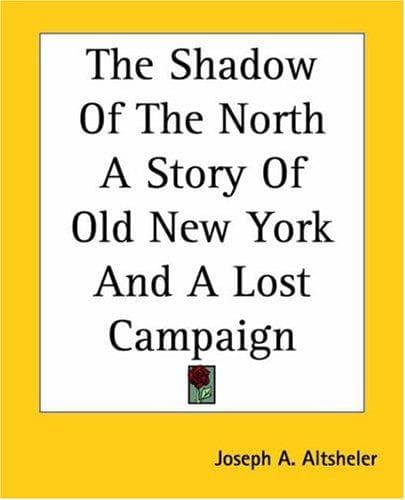
The Shadow of the North: A Story of Old New York and a Lost Campaign — John Shaqi
The Shadow of the North: A Story of Old New York and a Lost CampaignAltsheler, Joseph A. (Joseph Alexander)
History
The Shadow of the North: A Story of Old New York and a Lost Campaign
Altsheler, Joseph A. (Joseph Alexander)
United States -- History -- French and Indian War, 1754-1763 -- Juvenile fiction
Robert and Tayoga nodded and the three remained silent while the night
came. The blazing red in the west faded rapidly and darkness swept
down over the wilderness. The three, each leaning against his tree,
did not move but kept their rifles across their knees ready at once
for possible use. Tayoga had fastened his bow over his back by the
side of his quiver, and their packs were adjusted also.
Robert was anxious not so much for himself as for the unknown others
who were marching through the wilderness, and for whom the French and
Indians were laying an ambush. It had been put forward first as a
suggestion, but it quickly became a conviction with him, and he felt
that his comrades and he must act as if it were a certainty. But no
sound that would tell them which way to go came out of this black
forest, and they remained silent, waiting for the word.
The night thickened and they were still uncertain what to do. Robert
made a silent prayer to the God of the white man, the Manitou of the
red man, for a sign, but none came, and infected strongly as he was
with the Indian philosophy and religion, he felt that it must be due
to some lack of virtue in himself. He searched his memory, but he
could not discover in what particular he had erred, and he was forced
to continue his anxious waiting, until the stars should choose to
fight for him.
Tayoga too was troubled, his mind in its own way being as active as
Robert's. He knew all the spirits of earth, air and water were abroad,
but he hoped at least one of them would look upon him with favor, and
give him a warning. He sought Tododaho's star in the heavens, but the
clouds were too thick, and, eye failing, he relied upon his ear for
the signal which he and his young white comrade sought so earnestly.
If Tayoga had erred either in omission or commission then the spirits
that hovered about him forgave him, as when the night was thickest
they gave the sign. It was but the faint fall of a foot, and, at
first, he thought a bear or a deer had made it, but at the fourth or
fifth fall he knew that it was a human footstep and he whispered to
his comrades:
"Some one comes!"
As if by preconcerted signal the three arose and crept silently into
the dense underbrush, where they crouched, their rifles thrust
forward.
"It is but one man and he walks directly toward us," whispered Tayoga.
"I hear him now," said Robert. "He is wearing moccasins, as his step
is too light for boots."
"Which means that he's a rover like ourselves," said Willet. "Now he's
stopped. There isn't a sound. The man, whoever he is, has taken alarm,
or at least he's decided that it's best for him to be more
watchful. Perhaps he's caught a whiff from the ashes of our fire. He's
white or he wouldn't be here alone, and he's used to the forest, or he
wouldn't have suspected a presence from so little."
Public-domain text, read in full here on John Shaqi.
Reviews
Reviews
No reviews yet
Be the first to share your thoughts on this work.
Join the Discussion
Join the discussion
Sign in to leave a comment or review.
Sign InorCreate an account