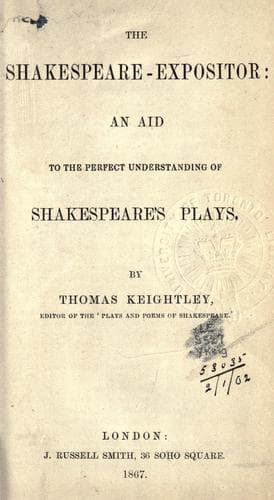
The Shakespeare-Expositor: An Aid to the Perfect Understanding of Shakespeare's PlaysKeightley, Thomas
General
The Shakespeare-Expositor: An Aid to the Perfect Understanding of Shakespeare's Plays
Keightley, Thomas
Drama -- Outlines, syllabi, etc.; Shakespeare, William, 1564-1616 -- Outlines, syllabi, etc.
'Strange' is a very feeble word here. If, as I have ventured to do,
we read '_sable_ snow,' we have a parallel to 'hot ice.' Upton read
_black_; Staunton _swarthy_; Hanmer _scorching_.
* * * * *
"And what poor duty cannot do, noble respect
Takes it in might not merit."
As there are no short lines in this play, I think a word has been lost
in the first line. I read _faltering_, Theobald read '_willing_ duty.'
* * * * *
"His speech was like _unto_ a tangled chain."
* * * * *
"This grisly beast, which lion hight by name,
The trusty Thisby, coming first by night.
* * * * *
Did scare away, or rather did affright."
A line riming with the first appears to be lost. Some read 'by name
hight,' making a triplet; but I cannot agree with them.
* * * * *
"Here come two noble beasts in, A lion and a man."
Theobald reads _moon_ for 'man.' The correction is ingenious, but not
certain. I have, however, adopted it.
* * * * *
"A lion-fell, but else no lion's dam."
So Singer reads; others 'A lion'_s_ fell.'
* * * * *
"For by thy gracious, golden, glittering streams."
This is the reading of the 2nd folio; for the old editions repeat
'beams' from the preceding line. "Phebus of _gold his stremès_ down
hath sent" (Chauc. Merch. Tale), was probably in the poet's mind; or
"Which erst so glistened with the _golden streams_,
That cheerful Phoebus spred down from his sphere."
(Induct. to Mir. for Magistrates.)
* * * * *
"Would go _well_ near to make a man look sad.--
Beshrew my heart, but I _do_ pity the man."
* * * * *
"These lily lips
This cherry nose."
Rime demands Theobald's 'lily _brows_.'
* * * * *
SC. 2. "Now the hungry lion roars,
And the wolf behowls the moon."
'Behowls' is Warburton's correction of _beholds_ of the originals. It
is proved to be right by the following passage of Marston's Antonio's
Revenge:--
"Now barks the wolf against the full-cheek'd moon,
Now lions' half-clamm'd entrails roar for food" (iii. 3).
As this play was not printed till 1602, this may be an imitation of the
passage of our text.
* * * * *
"Ever shall in safety rest,
And the owner of it blest."
Public-domain text, read in full here on John Shaqi.
Reviews
Reviews
No reviews yet
Be the first to share your thoughts on this work.
Elsewhere in the archive
Join the Discussion
Join the discussion
Sign in to leave a comment or review.
Sign InorCreate an account