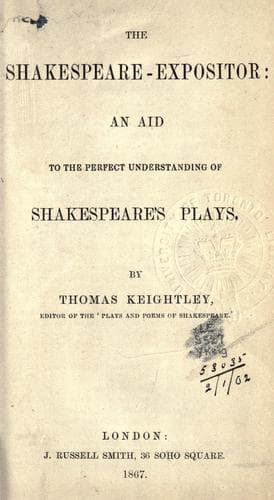
The Shakespeare-Expositor: An Aid to the Perfect Understanding of Shakespeare's PlaysKeightley, Thomas
General
The Shakespeare-Expositor: An Aid to the Perfect Understanding of Shakespeare's Plays
Keightley, Thomas
Drama -- Outlines, syllabi, etc.; Shakespeare, William, 1564-1616 -- Outlines, syllabi, etc.
For 'news' Collier's folio, followed by Singer, reads _means_. I think
they are right.
* * * * *
"I with the morning's love have oft made sport."
Rowe read _light_ for 'love,' and Johnson and Singer have followed him.
But it seems to be Cephalus that is meant.
ACT IV.
SC. 1. "Which straight she gave me and her fairy sent."
It should be 'fairie_s_.' (See on ii. 1.)
* * * * *
"All may to Athens back again repair."
The reading hitherto has been 'May all,' but the transposition restores
the grammar.
* * * * *
"Dian's bud o'er Cupid's flower."
The 4to and folio read _or_. The correction is Thirlby's.
* * * * *
"Trip we after nightès shade."
Fisher's 4to has 'nights,' of which I have made a dissylable, as being
more Shakespearean than 'the night's' of the folio and Roberts' 4to,
which most feebly and inharmoniously throw the emphasis on 'the.' This
gen. occurs more than once in our poet's earlier plays.
* * * * *
"When in a wood of Crete they bay'd the bear."
With Hanmer I incline to read _boar_.
* * * * *
"The woods, the fountains, every region round."
Here, too, I suspect that the poet wrote '_m_ountains.' 'Seem'_d_ in
next line is the reading of the 2nd folio; the originals have _seeme_.
* * * * *
"Was to be gone from Athens where we might
Without the peril of the Athenian law...."
This is the reading of Fisher's 4to; Roberts' and the folio read 'might
be'; which does not suit the metre of this play. Egeus breaks in and
interrupts him.
* * * * *
"Melted, _e'en_ as the snow, seems to me now."
"It wasted and consum'd _even_ like ice
That by the vehemence of heat dissolveth."
Green's Tu Quoque.
The ordinary correction is that of Capell, 'as _doth_'; an Anon. read
'_All_ melted.'
* * * * *
"Was I betroth'd ere I saw Hermia;
But, like in sickness, did I loathe this food."
'Saw' is Steevens' correction of _see_; in L. L. L. iv. 1, we have "I
came, _see_ and overcame." 'In sickness' is Farmer's correction of 'a
sickness' of the originals.
* * * * *
"Mine own and not mine own.--_But_ are you sure
That we are _yet_ awake? It seems to me."
The folio omits 'are ... awake.' Capell also added _But_ and an Anon.
_yet_. The poet's words may, however, have been, "Are you sure we
are awake? it seems to me." But that would make the preceding speech
terminate in a manner that does not occur in this play.
ACT V.
SC. 1. "That is hot ice, and wondrous strange snow."
Public-domain text, read in full here on John Shaqi.
Reviews
Reviews
No reviews yet
Be the first to share your thoughts on this work.
Elsewhere in the archive
Join the Discussion
Join the discussion
Sign in to leave a comment or review.
Sign InorCreate an account