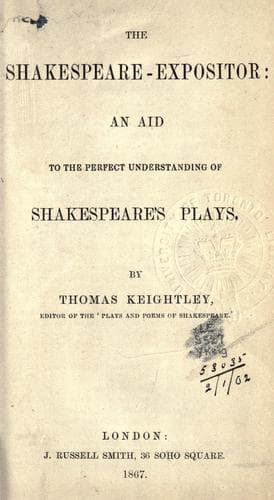
The Shakespeare-Expositor: An Aid to the Perfect Understanding of Shakespeare's PlaysKeightley, Thomas
General
The Shakespeare-Expositor: An Aid to the Perfect Understanding of Shakespeare's Plays
Keightley, Thomas
Drama -- Outlines, syllabi, etc.; Shakespeare, William, 1564-1616 -- Outlines, syllabi, etc.
"_To_ set foot under thy table. Tut, a toy."
"Do get their children; but in this case of wooing
A child shall get a sire, if I fail not of my cunning."
Rime demands for 'cunning' the reading of Steevens, _doing_. _Wooing_
and _doing_ have already rimed in this scene. (See also Tr. and Cr. i.
2, _ad fin._)
ACT III.
SC. 1. "Spit in the hole, man, and tune _it_ again."
* * * * *
"To charge true rules for old inventions."
All are agreed to read _change_ with 2nd folio; and as 'old' evidently
makes no sense, Theobald read _odd_. With Rowe I prefer _new_. (See
Introd. p. 66.)
* * * * *
SC. 2. "Make friends, invite, and proclaim the banns."
The 2nd folio adds _yes_, Malone _them_, Dyce _guests_ after 'invite';
my own conjecture was _aye_. Would it not be better, however, to read
as I have done, "Make friends _be_ invite_d_, and proclaim the banns"?
There is an exactly similar omission of _be_ in All's Well, i. 3, where
there can be no doubt. We might also read simply 'friends invite_d_';
but I doubt, after all, if it were not best to read "Make invite
friends _too_ and proclaim the banns," which would agree better with
the character of the speaker.
* * * * *
"Master, master! news, and such news as you never heard of.--
Is it new and old too? how may that be?"
Is it quite evident that _old_ has been omitted in the first line.
Rowe, who is followed, prefixed it to the first 'news.' I think it is
better with the second, as in Collier's folio.
* * * * *
"Often burst, and now_'s_ repaired with knots."
* * * * *
"And 'The Humours of forty Fancies.'"
Collier's folio reads "The Amours or forty Fancies."
* * * * *
"Were it _not_ better I should rush in thus...."
Sense and metre demand the negative. There is, I think, a break in
sense at the end of the line.
* * * * *
"But, sir, _to her_ love concerneth us to add
Her father's liking."
So I find Tyrwhitt also correctly completed the line.
* * * * *
"Signior Gremio, _how_ came you from the church."
* * * * *
"I'll tell you, sir Lucentio. When the priest."
For 'sir' we should most certainly read _signior_. (See on Induction,
sc. 1.)
* * * * *
"Having no other reason, etc."
This speech is prose in the 1st folio; in the 2nd it is arranged as
verse, but not well. In my Edition I have rearranged it, as I find Reed
also had done.
* * * * *
"My household stuff, my field, my barn, _my granary_."
S. Walker conjectured _my grange_; the Cambridge editors _my garner_.
ACT IV.
SC. 1. "Out, _out_ you rogue! you pluck my foot awry."
* * * * *
Public-domain text, read in full here on John Shaqi.
Reviews
Reviews
No reviews yet
Be the first to share your thoughts on this work.
Elsewhere in the archive
Join the Discussion
Join the discussion
Sign in to leave a comment or review.
Sign InorCreate an account