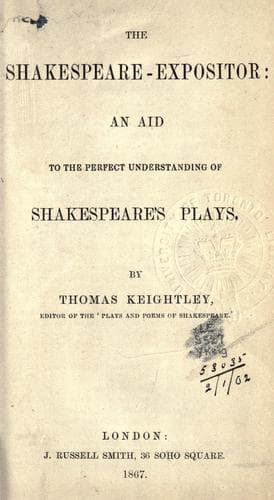
The Shakespeare-Expositor: An Aid to the Perfect Understanding of Shakespeare's PlaysKeightley, Thomas
General
The Shakespeare-Expositor: An Aid to the Perfect Understanding of Shakespeare's Plays
Keightley, Thomas
Drama -- Outlines, syllabi, etc.; Shakespeare, William, 1564-1616 -- Outlines, syllabi, etc.
SC. 3. "If a Christian do not play the knave and get thee."
The 2nd folio properly read _did_. (See on Jul. Cæs. ii. 2.) This
change of tense was not unfrequent. We often meet _see_ for _saw_.
* * * * *
SC. 5. "Well thou shalt see; thy eyes shall be thy judge."
It might be better to read '_the_ judge.' Even at the present day
printers confound these words.
* * * * *
"Will be worth a Jewès eye,"
I prefer this, the reading of the old copies, to 'Jewess,' Pope's
reading, which is usually followed.
* * * * *
SC. 6. "How like a younker or a prodigal."
Rowe's correction for 'younger.'
* * * * *
SC. 7. "Go draw aside the curtains."
So also at end of scene; but as in sc. ix. it is 'curtain,' I ascribe
the _s_ to the printer.
* * * * *
"But more than these in love I do deserve _her_."
See also Capell.
* * * * *
"Gilded timber do worms infold."
Pope read _wood may_ for 'timber do' of the 4tos and folio; Johnson,
who is always followed, read _tombs_; I read _woods_. The meaning is
that gilded wooden work was often worm-eaten.
ACT III.
SC. 1. "And hindered me _of_ half a million."
So also Warburton.
* * * * *
"Where? in Genoa?"
'Where' is Rowe's correction; the original editions read _Here_, which
may be right.
* * * * *
SC. 2. "I speak too long, but 'tis to piece the time,
To eke it, and to draw it out."
'Piece' is Rowe's correction for _peize_, and is, I think, right.
* * * * *
"There is no vice so simple but assumes."
The originals all have _voice_; 'vice' is a correction, and a true one,
of the 2nd folio.
* * * * *
"Thus ornament is but the guiled shore
To a most dangerous sea, the beautious scarf
Veiling an Indian beauty."
Unless we take it ironically--which is unworthy of the poet--'beauty'
here is nonsense. It plainly owes its origin to the preceding
'beautious.' Hanmer read _dowdy_; Sidney Walker _gipsy_--both bad. I
read, with the utmost confidence, _feature_ as the only word suited
to the place. (See Index _s. v._) Mr. Spedding, I find, conjectured
_visage_ or _feature_, apparently taking them to be synonymous.
* * * * *
"Nor none of thee, thou pale and common drudge."
For 'pale' Farmer read _stale_, perhaps needlessly.
* * * * *
"Thy paleness moves me more than eloquence."
Public-domain text, read in full here on John Shaqi.
Reviews
Reviews
No reviews yet
Be the first to share your thoughts on this work.
Elsewhere in the archive
Join the Discussion
Join the discussion
Sign in to leave a comment or review.
Sign InorCreate an account