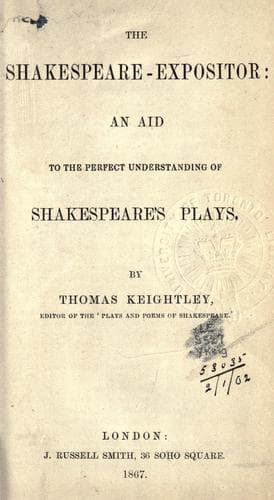
The Shakespeare-Expositor: An Aid to the Perfect Understanding of Shakespeare's PlaysKeightley, Thomas
General
The Shakespeare-Expositor: An Aid to the Perfect Understanding of Shakespeare's Plays
Keightley, Thomas
Drama -- Outlines, syllabi, etc.; Shakespeare, William, 1564-1616 -- Outlines, syllabi, etc.
Warburton read _plainness_, of which Mr. Dyce approves, and perhaps
with reason. I have, however, made no change. Lead in fact never is
pale; for its surface is always oxydized. Shakespeare, moreover, would
hardly use the same term of two distinct substances. (See, however, on
Rom. and Jul. ii. 5.)
* * * * *
SC. 3. "The Duke cannot deny the course of law,
For the commodity that strangers have
With us in Venice. If it be denied
'_T_will much impeach the justice of the state."
I thus point and amend the passage, as Capell had done, followed only,
I believe, by Knight. I am rather dubious of 'justice,' and should
prefer _interest_ or _traffic_.
* * * * *
SC. 4. "From out the state of hellish misery."
I prefer 'misery,' the reading of the first 4to, to _cruelty_, that of
the others and the folio.
* * * * *
"As I have ever found thee honest-true."
These compounds of two adjectives--the first being used
adverbially--are not by any means uncommon. They are frequent in
Shakespeare; in Fletcher's Hum. Lieut. (iii. 2) we have "serious-true,"
and in his Chances (ii. 1) "glorious-foolish." (See on 1 Hen. IV. iii.
1.)
* * * * *
"In speed to Padua; see thou render this."
All the old editions read _Mantua_, but it is so certain that it must
have been a mere slip of the poet or the printer that Theobald's
correction has been universally and properly adopted. (See on Hen. V.
iii. Chor.)
* * * * *
"Unto the Tranect, to the common ferry."
Rowe, I think properly, read _Traject_ (_tragetto_ It.).
* * * * *
SC. 5. "And if on earth he do not mean it, then."
Here 'it' seems to mean 'to live an upright life'; rather a harsh
construction. It is not likely that the poet used 'mean' in the sense
of _mener_ Fr., yet it seems to be used so sometimes in Piers Ploughman.
ACT IV.
SC. 1. "Cannot contain their urine; for Affection,
Masters of passion, sways it to the mood
Of what it likes or loathes."
The original editions all read "Cannot contain their urine for
affection;" but that this cannot be right is proved by the context.
The only question then is, should we read _Master_ with Thirlby, or
_Mistress_ with the same and Capell. Nothing (see Introd. p. 59) is
more common than the addition of _s_, while _master_ and _mistress_ are
frequently confounded. (See on Taming of Shrew, i. 2.) On the whole, I
prefer _mistress_. In the last line I read _she_ for 'it,' evidently
caused by that in the preceding line. For the meaning of 'affection,'
see Index _s. v._
* * * * *
"Why he a woollen bag-pipe."
Public-domain text, read in full here on John Shaqi.
Reviews
Reviews
No reviews yet
Be the first to share your thoughts on this work.
Elsewhere in the archive
Join the Discussion
Join the discussion
Sign in to leave a comment or review.
Sign InorCreate an account