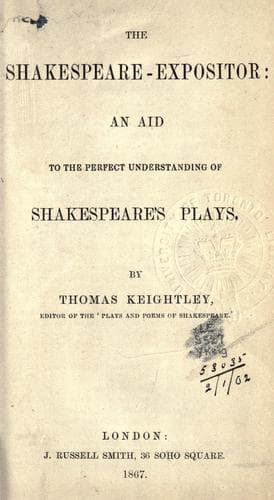
The Shakespeare-Expositor: An Aid to the Perfect Understanding of Shakespeare's PlaysKeightley, Thomas
General
The Shakespeare-Expositor: An Aid to the Perfect Understanding of Shakespeare's Plays
Keightley, Thomas
Drama -- Outlines, syllabi, etc.; Shakespeare, William, 1564-1616 -- Outlines, syllabi, etc.
"But justly, as you have exceeded all promise _here_."
Hanmer read '_here_ exceeded.'
* * * * *
"But yet indeed the taller, is his daughter."
For 'taller' Pope read _shorter_, Malone _smaller_, which is the usual
reading, as Rosalind was 'the taller.' I feel, however, almost certain
that the poet wrote '_less_ taller,' and have so printed it. We have,
"Against the envy of _less happier_ lands" (Rich. II. ii. 1), and no
one would object to _more taller_.
* * * * *
SC. 3. "Not a word!--No, not one to throw at a dog."
The 'No,' it will be seen, was transferred to the beginning of the next
speech, where it was not wanted; while both sense and metre require it
here.
* * * * *
"No, some of it for my child's father."
Rowe properly read 'father's child.' Sense, taste, and delicacy, alike
commend this simple and natural transposition. Some editors, however,
think otherwise.
* * * * *
"Mistress, dispatch you with your safest haste."
For 'safest' Collier's folio reads _fastest_; we might also read, with
Singer, _swiftest_, like "_swiftest_ expedition" (Two Gent. iii. 1);
"in all _swift haste_" (Tr. and Cr. i. 1). But it is not necessary to
alter the text; for _safe_ is, sure, certain, a sense which it retains
in the Midland counties. "To take the safest occasion by the front"
(Oth. iii. 2).
* * * * *
"Which teacheth thee, that thou and I am one."
Such was the structure of the time. "My thoughts and I _am_ for this
other element" (Jonson, Cynthia's Revels, i. 1). It was the same in
French:
"Ni la mort ni vous-même
Ne me _ferez_ jamais prononcer que je l'aime."
Racine, Bajazet, iv. 1.
ACT II.
SC. 1. "Here feel we not the penalty of Adam,
The season's difference," etc.
As the Duke proceeds to show that he _did_ feel this difference, the
text cannot be right. Critics, therefore, for 'not' read _but_, as
these words were frequently confounded by the printers. But then a
question arises, was 'the season's difference' any part of 'the penalty
of Adam.' In Scripture that penalty was "in the sweat of thy face shalt
thou eat bread;" and this was the very penalty that the Duke and his
friends did not feel; for we have just been told of them (i. 1) that
"they fleet away the time carelessly, as they did in the Golden World."
Further, it does not appear that any writer anterior to Milton made
the Ovidian change of seasons a part of Adam's penalty. The text may
therefore be right, and a line, something like this, have been lost,
"Here is no toil; we have only to endure"
* * * * *
"I would not change it."
Upton, most properly, made this the conclusion of the Duke's speech.
(See on W. T. v. 1)
* * * * *
Public-domain text, read in full here on John Shaqi.
Reviews
Reviews
No reviews yet
Be the first to share your thoughts on this work.
Elsewhere in the archive
Join the Discussion
Join the discussion
Sign in to leave a comment or review.
Sign InorCreate an account