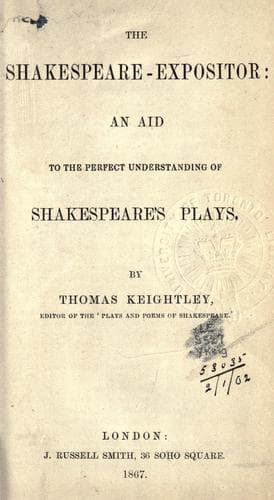
The Shakespeare-Expositor: An Aid to the Perfect Understanding of Shakespeare's PlaysKeightley, Thomas
General
The Shakespeare-Expositor: An Aid to the Perfect Understanding of Shakespeare's Plays
Keightley, Thomas
Drama -- Outlines, syllabi, etc.; Shakespeare, William, 1564-1616 -- Outlines, syllabi, etc.
"First for his weeping into the needless stream."
Pope's change of 'into' to _in_ has been generally followed, but
without the slightest reason, by the decasyllabists. I am almost
ashamed to say that I have joined them from pure inadvertence.
* * * * *
"Left and abandon'd of his velvet friends."
* * * * *
"The body of _the_ country, city, court."
The 2nd folio supplied _the_.
* * * * *
"Send to his brother's; fetch that gallant hither."
* * * * *
SC. 3. "When service should in my old limbs lie lame,
And unregarded age in corners thrown."
There is either a line lost after these, or we should read '_be_
in corners thrown,' as I have done. The omission of _be_ was not
infrequent.
* * * * *
"The constant service of the antique world,
When service sweat for duty not for meed."
The 'service' in the first line arose from that in the second (See
Introd. p. 64). I read _fashion_; Collier's folio has _favour_.
* * * * *
"From seventy years, till now almost fourscore."
Such is the reading of the folio--a convincing proof of how little the
old printers are to be relied on. Editors, without exception, read
_seventeen_.
* * * * *
SC. 4. "O Jupiter, how weary are my spirits!"
'Weary' is Warburton's correction of _merry_ of the folio.
* * * * *
"I pray you bear with me; I cannot go no further."
For 'cannot' the 2nd folio has _can_, the usual reading. Yet I doubt if
the change was needed.
* * * * *
"From whom I took two cods."
Johnson read, as every man of sense would read, _peas_ for 'cods.' I
have just shown the origin of the change.
* * * * *
SC. 5. "And turn his merry note."
We still say _turn a tune_ and a _note_. Pope, then, was wrong in
reading _tune_ for 'turn.' "When threadbare Martial _turns his merry
note_" (Hall. Sat. vi. 1) was probably in the poet's mind.
* * * * *
SC. 7. "Doth very foolishly, although he smart,
_Not to_ seem senseless of the bob."
Both sense and metre demand this addition of Theobald's, whom all
editors follow. We have the very same omission in
"Yet if it be your wills _not to_ forgive
The sin I have committed, let it not fall," etc.
Philaster, ii. 4.
where none of the editors have perceived the loss.
* * * * *
"Why who cries out on pride."
Public-domain text, read in full here on John Shaqi.
Reviews
Reviews
No reviews yet
Be the first to share your thoughts on this work.
Elsewhere in the archive
Join the Discussion
Join the discussion
Sign in to leave a comment or review.
Sign InorCreate an account