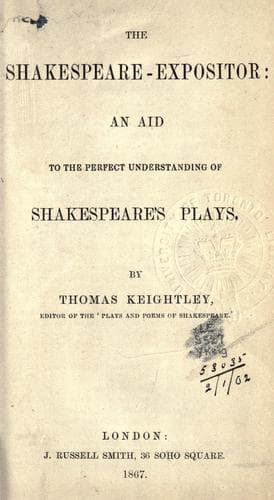
The Shakespeare-Expositor: An Aid to the Perfect Understanding of Shakespeare's PlaysKeightley, Thomas
General
The Shakespeare-Expositor: An Aid to the Perfect Understanding of Shakespeare's Plays
Keightley, Thomas
Drama -- Outlines, syllabi, etc.; Shakespeare, William, 1564-1616 -- Outlines, syllabi, etc.
* * * * *
"Bring us _un_to this sight, and you shall say."
* * * * *
SC. 5. "Than he that dies and lives by bloody drops."
It is quite impossible that this line in its present form could have
come from the pen of the poet. He must have seen the absurdity of dying
before living, and he could have had no motive for departing from the
universal form "live and die," as in "I could live and die in the eyes
of Troilus" (Tr. and Cr. i. 2). If we then transpose, and take 'by'
in the sense of beside, near, in contact with (Index _s. v._), we get
excellent sense. 'Dies,' however, may be a printer's error for some
other verb--_sheds_ perhaps; and then 'by' may be taken in its ordinary
sense. I had also, like Heath, conjectured '_daily_ lives.'
* * * * *
"The cicatrice and capable impression."
For 'capable' Singer's and Collier's folio read _palpable_; I have
followed them.
"Nor I am sure there is no force in eyes
That can do hurt to any _one_.--O! dear Phebe."
For 'Nor' we might perhaps better read _And_. (See my note on Sam.
Agon., 1692.) Still no change is needed.
* * * * *
"That you insult and exult all at once
Over the wretched? What! though you have no beauty."
The transposition in the first line removes all necessity for
correction. Strange that the critics should not have thought of it!
In my Edition the transposition is, "That you insult and all at once
exult," which is wrong; but it is there corrected. By reading 'What!'
the difficulty found here by critics is removed.
* * * * *
"That the old Carlot once was master of."
In the folio 'Carlot' is printed as a proper name, and it may be the
Spanish _Carloto_. No such substantive as 'carlot' is known.
* * * * *
"He is fallen in love with your foulness, and she'll."
For 'she' we should, I think, read, as I have done, _you_.
* * * * *
"_I_ have more cause to hate him than to love him."
The _I_ was supplied in the 2nd folio.
ACT IV.
SC. 1. "And the foolish chroniclers of the age found it was--Hero
of Sestos."
The use of the word 'found' proves that Hanmer's reading _coroners_ is
right. In Twelfth Night (i. 5) the coroner is said to sit on a drowned
man.
* * * * *
"That cannot make her fault her husband's occasion."
This seems to mean occasioned, caused by her husband. Or we may read,
with Hanmer, _accusation_. I find I have done so, but doubt if I was
justified in so doing.
* * * * *
"I'll go find a shadow and sigh till he come.--And I'll _go_ sleep."
Both sense and metre seem to demand this addition.
* * * * *
SC. 3. "My gentle Phebe did bid me give you this."
Public-domain text, read in full here on John Shaqi.
Reviews
Reviews
No reviews yet
Be the first to share your thoughts on this work.
Elsewhere in the archive
Join the Discussion
Join the discussion
Sign in to leave a comment or review.
Sign InorCreate an account