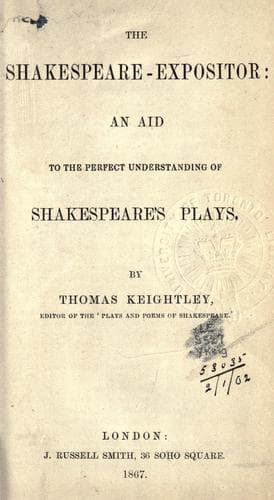
The Shakespeare-Expositor: An Aid to the Perfect Understanding of Shakespeare's PlaysKeightley, Thomas
General
The Shakespeare-Expositor: An Aid to the Perfect Understanding of Shakespeare's Plays
Keightley, Thomas
Drama -- Outlines, syllabi, etc.; Shakespeare, William, 1564-1616 -- Outlines, syllabi, etc.
There is something wanting here; for in this play the speeches never
begin thus with a short line. It is evident also that it is one
kind of pride, that of dress, that is spoken of. I therefore read
without hesitation 'pride of _bravery_,' and, three lines further on,
_wearer's_ for 'weary,' in which I had been anticipated by Singer.
* * * * *
"Of what kind should this cock come of."
This seems to be a third instance of effacement in a single page of the
MS. I would add _I marvel_.
* * * * *
"And take upon command what help we have."
"And in his room not only to eat his fill, but _be the lord_ of the
feast." (Lodge, Rosalynde, p. 53.) "They covet not their neighbours'
goods; but _command_ all that is their neighbours' as their own." (MS.,
1559, _ap._ Froude, Hist. of Eng. viii. 3.)
* * * * *
"_And_ then the whining schoolboy."
This is a proper addition of Pope's.
ACT III.
SC. 2. "Here comes young master Ganymede, my new mistress['s]
brother."
Though it stands thus in the folio, metre and the usage of the time
reject the _s_.
* * * * *
"But the fair of Rosalind."
We might read 'fair _face_,' or, with Rowe, _face_ for 'fair'; which
last, however, is the same as fairness; so no change is needed.
* * * * *
"Winter'd garments must be lined."
The 3rd folio properly reads _Winter_.
* * * * *
"Why should this desert be?"
Rowe read '_a_ desert'; Tyrwhitt '_silent_ be.' I rather prefer the
latter; but it is against it that, excepting in one of the following
and the six last lines, the first foot is always monosyllabic. I have
therefore followed Rowe.
* * * * *
"Or at every sentence end."
For 'Or' I read _And_. (See Note at end of Samson Agonistes in my
Edition of Milton's Poems.)
* * * * *
"It may well be called Jove's tree when it drops forth fruit."
The 2nd folio reads 'forth _such_; Capell read _such_ for 'forth.'
Perhaps the first is to be preferred; yet I find I have followed Capell
in my Edition.
* * * * *
"_Make_ me believe it! You may as soon make her."
Surely the passage thus gains not only in metre, but in spirit.
* * * * *
SC. 3. "By so much is a horn more precious than to want."
There is apparently an aposiopesis here.
* * * * *
"Leave me not behind thee, _prythee_."
Both rime and metre require this addition; yet none of the critics has
made it.
* * * * *
SC. 4. "Breaks his staff like a noble goose."
Singer, very unnecessarily and most tamely, reads _notable_ for
'noble.' Printing from his edition, I have heedlessly followed him in
mine.
Public-domain text, read in full here on John Shaqi.
Reviews
Reviews
No reviews yet
Be the first to share your thoughts on this work.
Elsewhere in the archive
Join the Discussion
Join the discussion
Sign in to leave a comment or review.
Sign InorCreate an account