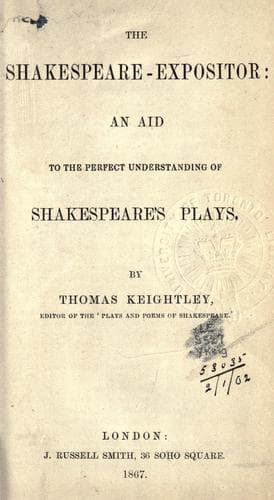
The Shakespeare-Expositor: An Aid to the Perfect Understanding of Shakespeare's PlaysKeightley, Thomas
General
The Shakespeare-Expositor: An Aid to the Perfect Understanding of Shakespeare's Plays
Keightley, Thomas
Drama -- Outlines, syllabi, etc.; Shakespeare, William, 1564-1616 -- Outlines, syllabi, etc.
We have a similar sentiment in Cymb. v. 1. As _of ice_ and _of vice_
are pronounced exactly alike, we may safely assume the latter to be
the true reading. The whole difficulty then lies in 'brakes.' A brake
was certainly, as we are told, a frame to confine restless or vicious
horses in when shoeing; but when it is added that it is also an
instrument of torture, I become somewhat dubious. At any rate no one
would say a rack or a gibbet of vice; so why a brake of vice? I incline
then, but with hesitation, to think that we should read _wreaks o'
vice_. We have "wreak the love" (R. and J. iii. 5); "wreak our wrongs."
(Tit. And. iv. 3.) I put the ambiguous _o'_, because _wreak_ takes _on_
rather than _of_ after it.
* * * * *
"I thought by the readiness in the office, you had," etc.
For 'by the,' the usual correction (which I have followed) is 'by
_your_.' Mr. Collier thinks 'by _this_' might be better; for _this_ and
_your_ were used promiscuously. Either might easily be confounded with
_the_. (See Introd. p. 68.)
* * * * *
SC. 2. "But you might do it, and do the world no wrong."
This apparently necessary transposition was made by S. Walker. The
folio reads "But might you."
* * * * *
"May call it _back_ again. Well, believe this."
Here _back_ is the proper addition made in the 2nd folio.
* * * * *
"Becomes them not with half so fair a grace
As mercy does. If he had been as you,
And you as he, you would have slipped like him,
But he, like you, would not have been so stern."
* * * * *
"Why, all the souls that were were forfeit once."
As the first 'were' may have been caused by the second, I would, like
Warburton, read for it _are_. In "We cannot cross the cause why we were
born" (L. L. L. iv. 3), the folio reads '_are_ born.'
* * * * *
"If the first that did th' edict infringe."
So it stands in the folio, and Pope was, it may be, right in reading
'If the first _man_,' but we might also read, and perhaps better, as I
have done, 'the edict did.'
* * * * *
"Either now, or by remissness new-conceiv'd."
For 'now' I felt inclined to read _new_, with Pope, but I prefer 'now
_born_,' and so I have printed it. (See on All's Well, ii. 3.)
* * * * *
"Are now to have no successive degrees
But here they live to end."
We should for 'here' either read _where_, or better, with Hanmer, _ere_.
* * * * *
"Would use his heaven for thunder; nothing but thunder!
Merciful Heaven!"
* * * * *
"Than the soft _yielding_ myrtle; but man, proud man!"
"That soft and _yielding_ mind should not be in him."
Lyly, Campaspe, ii. 2.
Public-domain text, read in full here on John Shaqi.
Reviews
Reviews
No reviews yet
Be the first to share your thoughts on this work.
Elsewhere in the archive
Join the Discussion
Join the discussion
Sign in to leave a comment or review.
Sign InorCreate an account