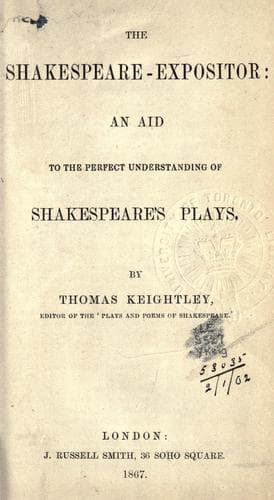
The Shakespeare-Expositor: An Aid to the Perfect Understanding of Shakespeare's PlaysKeightley, Thomas
General
The Shakespeare-Expositor: An Aid to the Perfect Understanding of Shakespeare's Plays
Keightley, Thomas
Drama -- Outlines, syllabi, etc.; Shakespeare, William, 1564-1616 -- Outlines, syllabi, etc.
"A very obscure passage," says Mr. Dyce, "in which Rowe printed '_by_
weakness,' and Malone proposes '_this_ weakness.' (On 'fedary' see
Richardson's Dictionary, _sub_ Federal.)" And this is all this noted
critic has to say! For my part I do not regard this passage as by any
means past cure, and I think that Warburton came very near the true
sense. The main point is to ascertain the exact meaning of _fedary_.
"_Federy_ and _federary_," says Richardson, "in Shakespeare are the
same word differently written (having no connexion whatever with _Feud_
or _Feudatory_), and signify a colleague, associate, or _confederate_;"
and he refers to Minshew, _s. v._ Feodarie. Now Minshew's words are
"Feodarie _alias_ Feudaris _alias_ Feudatrie, Feudelarius, is an
office authorized by the Master of the Court of Wards and Liveries by
letters patent, and under the seal of that office," etc. Cotgrave has
"A feodarie, _feudal_, _feodal_, _feudataire_;" in both of which places
I think the "connexion with _Feud_ and _feudatory_" is very apparent;
and the last convinces me that a _fedary_ or _feodary_ was a vassal, a
liegeman; and that, I have no doubt, is its sense in this place? and
in Cymb. iii. 2, where it again occurs, as I shall there show. I do
not think Richardson was at all justified in making, as he seems to
do, _fedary_ a different word from _feodary_. There was also _feodar_
a vassal, "For seventeen kings were Carthage _feodars_." (Marston.
Sophon. Prol.) It must strike every one of taste with surprise that
Shakespeare should have written such a leonine verse as
"If not a fedary, but only he."
And further, whether 'fedary' be vassal or confederate, the person
should be mentioned to whom he stood in that relation. In the former
sense--the only true one--that person must be either Heaven or the
Duke, which was omitted by the printer. I am in favour of the former,
both for metre-sake and because we have elsewhere, "The rest of your
_fees_, O Gods! the senators of Athens" (Tim. iii. 5); and "God's
_vassals_ drop and die" (Hen. V. iii. 2). I read thus:--
"We are all frail.--_Isab._ Else let my brother die.--
If not a fedary of _Heaven_, but only he,
Owe and succeed this weakness.... _Ang._ Nay, women are frail too."
Isabella replies at once, fully assenting to Angelo's observation.
After a brief pause, she is proceeding to reason on the subject, when
he interrupts her. We may observe that 'owe' and 'succeed' are legal
terms, which here form a hysteron-proteron, like some other common
phrases. Perhaps, indeed, we might transpose them; for Isabella is
speaking quite calmly and composedly. The change of 'thy' to _this_ is
perfectly legitimate; and _to_ may have been omitted or effaced after
'succeed.'
* * * * *
"Who would believe me? Oh! _these_ perilous mouths!"
The same addition was proposed by Mr. Seymour.
* * * * *
"To such abhorr'd pollution _as this_."
Public-domain text, read in full here on John Shaqi.
Reviews
Reviews
No reviews yet
Be the first to share your thoughts on this work.
Elsewhere in the archive
Join the Discussion
Join the discussion
Sign in to leave a comment or review.
Sign InorCreate an account