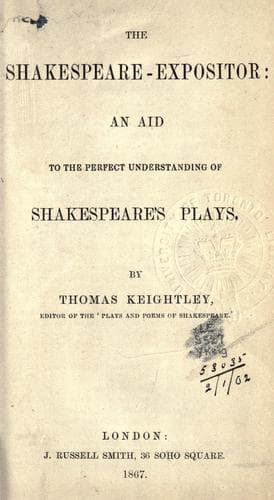
The Shakespeare-Expositor: An Aid to the Perfect Understanding of Shakespeare's PlaysKeightley, Thomas
General
The Shakespeare-Expositor: An Aid to the Perfect Understanding of Shakespeare's Plays
Keightley, Thomas
Drama -- Outlines, syllabi, etc.; Shakespeare, William, 1564-1616 -- Outlines, syllabi, etc.
Though this addition is not absolutely necessary, it gives such force
to the sentiment that I willingly believe it may have come from the
poet's pen.
ACT III.
SC. 1. "Servile to all the skyey influences
That dost this habitation, where thou keepest,
Hourly afflict."
No doubt 'dost' may make some sense here, but _do_, or rather, as more
Shakesperian, _doth_, makes far better sense. In Son. xxxix. there is
the very same confusion of _dost_ and _doth_.
* * * * *
"For thy complexion shifts to strange effects."
Johnson read _affects_, which seems to be better.
* * * * *
"And Death unloads thee.--Friend hast thou none."
There might seem to be no need of adding anything here. But we may
see that there is not an end of a paragraph. (See Introd. p. 82.) I
therefore read, 'And Death _in fine_.'
* * * * *
"For all thy blessed youth
Becomes as aged, and doth beg the alms
Of palsied Eld."
No sense has been made of 'as aged,' which may therefore be regarded
as corrupt. As in Tr. and Cr. v. 3, _as lawful_ should be _unlawful_,
I have here read in my Edition _engaged_ (also the reading of Mr.
Staunton) in the sense of dependent, in subjection, the ordinary state
of youth under the authority of parents and elders, depending on them
for money, etc. We might perhaps read _as gaged_ in the same sense, if
we had examples. The Cambridge editors propose _abased_, which is good,
and might easily have become 'as aged.' Possibly the poet wrote _an
abject_, as we have, "We are the Queen's _abjects_" (Rich. III. i. 1),
and "I will make thee stoop, thou _abject_" (Jonson, Ev. Man Out, etc.,
v. 3), "That thou wilt never let me live to be _An abject_" (Chapman,
Hymn to Venus, _v._ 312), "Yea, the very abjects" (Ps. xxxv. 15).
* * * * *
"What is yet in this
That bears the name of life? Yet in this life
Lie hid moe thousand deaths; yet death we fear."
For 'Yet,' caused by the other two, I read _Yea_; for 'moe' _some_, not
_more_, as is usual, and which makes no sense.
* * * * *
"Dear sir, ere long I'll visit thee again."
For 'sir' Mason, with whom I agree, reads _son_. Further on in the
scene the Duke calls him 'son.' (See on Cor. iii. 2.) It was perhaps
the following line that suggested 'sir' to the printer.
* * * * *
"Bring me to hear them speak."
So Steevens read, transposing the 'them' and 'me' of the folio; and
later editors have properly followed him.
* * * * *
"Now, sister, what's the comfort?--
Why, as all comforts are, most good, most good indeed."
This is the proper arrangement. Editors usually omit the first 'most
good,' to get their favourite decasyllabic verse, heedless of the loss
of force.
Public-domain text, read in full here on John Shaqi.
Reviews
Reviews
No reviews yet
Be the first to share your thoughts on this work.
Elsewhere in the archive
Join the Discussion
Join the discussion
Sign in to leave a comment or review.
Sign InorCreate an account