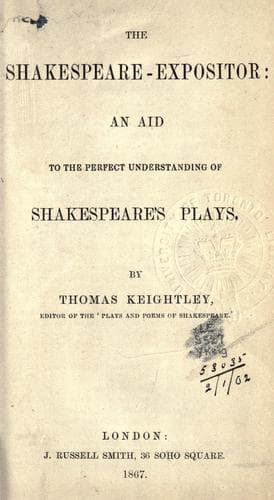
The Shakespeare-Expositor: An Aid to the Perfect Understanding of Shakespeare's PlaysKeightley, Thomas
General
The Shakespeare-Expositor: An Aid to the Perfect Understanding of Shakespeare's Plays
Keightley, Thomas
Drama -- Outlines, syllabi, etc.; Shakespeare, William, 1564-1616 -- Outlines, syllabi, etc.
* * * * *
"Think you I can a resolution fetch
From flowery tenderness?"
It appears to me that a negative is required to make the passage more
correct and natural; and we know how frequently it is omitted in these
plays. Here, however, I think, 'a' has been printed in its place (see
on Twelfth Night, ii. 2), for the compositor probably did not pronounce
the _t_ in 'cannot,' and so made it 'can a.' I therefore read, 'I
cannot resolution fetch.' Heath takes 'Think you' as imperative, not
interrogative, like _Bethink you_.
* * * * *
"Thou art too noble to preserve a life
In base appliances."
It might seem better to read _By_ than 'In'; but it is not safe to
meddle with prepositions. See on iv. 4.
* * * * *
"Nips youth in the head, and follies doth enmew
As falcon doth the fowl."
It is the falcon, not the fowl, that is enmewed. Would that every
correction were as certain as that which I have made here! I read, with
the fullest confidence, _enew_. (See Index _s. v._) It is a most curious
circumstance that in this place of the MS. I unconsciously wrote _bud_
for 'head,' a correction which was afterwards given in Notes and
Queries (3rd S. v. 229), and had, I believe, been previously proposed
by Grey. If 'head' be the right reading, it may signify the state of
bloom. "That unmatch'd form and feature of _blown_ youth" (Ham. iii. 1).
* * * * *
"The prenzie Angelo!--
Oh! 'tis the cunning livery of Hell
The damnedst bodie to invest and cover
In prenzie gardes."
So the passage stands in the folio. As there is no such word known in
English as 'prenzie,' the 2nd folio read _princely_, Hanmer _priestly_,
which Mr. Dyce adopts. I think, however, that the German Tieck hit on
the right word, _precise_, and I have so printed it without hesitation.
We have had already, "Lord Angelo is precise" (i. 4), "is severe" (ii.
1), and "well-seeming" (iii. 1); but it is nowhere said that he was
_princely_ or _priestly_, and surely the guards or bindings of a dress
could hardly be so termed. As to the change of accent, which Mr. Dyce
makes an objection, a reader of our old poets should be ashamed to urge
it, it is of such frequent occurrence, and it occurs more than once
in this very play. In i. 2 we actually have "précise villains," and
"A sort of sober, scurvy, precise neighbours" (Jonson, Alch. i. 1).
(See Introd. p. 80.) I further think we should read 'bodies,' and with
Collier's folio _garbs_, which being spelt _garbes_ differs only in
one letter from 'gardes.' As the latter were mere bindings, edgings,
facings, they could hardly be said to cover a body. The infinitives
'invest' and 'cover' are used (as so frequently) where we now use a
participle with an article. See Introd. p. 70.
* * * * *
"Yes.--Has he affections in him?"
Public-domain text, read in full here on John Shaqi.
Reviews
Reviews
No reviews yet
Be the first to share your thoughts on this work.
Elsewhere in the archive
Join the Discussion
Join the discussion
Sign in to leave a comment or review.
Sign InorCreate an account