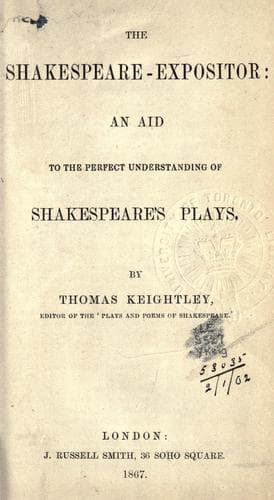
The Shakespeare-Expositor: An Aid to the Perfect Understanding of Shakespeare's PlaysKeightley, Thomas
General
The Shakespeare-Expositor: An Aid to the Perfect Understanding of Shakespeare's Plays
Keightley, Thomas
Drama -- Outlines, syllabi, etc.; Shakespeare, William, 1564-1616 -- Outlines, syllabi, etc.
"A passage," says Mr. Dyce, "in which it seems hopeless to ascertain
what the poet really wrote." At all events, by omitting 'To' in the
third line we get excellent sense, and what more need we require? After
I had made this simple emendation, I learned, to my great surprise--for
the editors gave no heed to it--that I had been anticipated in it by
Theobald. 'Draw' in the third line connects with 'may' in the first;
but the printer, taking 'practice' for a verb, added 'To' to try to
make sense. For 'making practice,' see on All's Well, iv. 2. 'Likeness'
is simulation: "Do not assume my likeness," _i.e._ pretend to be like
me. (Tim. iv. 3.) "Thou simular of virtue." (Lear iii. 2.) The poet
probably wrote 'crime' and 'time.'
ACT IV.
SC. 1. "There have I made my promise upon the
Heavy middle of the night to call upon him."
Capell, I think rightly, arranges thus:
"There have I made my promise to call upon him
Upon the heavy middle of the night."
Transpositions of this kind, made by the printers, are not uncommon.
(See on Tr. and Cr. v. 2.) Capell read 'on him.'
* * * * *
"Good Friar, I know you do, and _I_ have found it."
So Pope also conjectured.
* * * * *
"Run with these false and most contrarious quest."
I incline to read _their_. The 2nd folio added _s_ to 'quest.'
* * * * *
"Our corn's to reap, for yet our tithe's to sow."
Warburton properly read _tilth_.
* * * * *
SC. 2. "If it be too little for your thief," etc.
I quite agree with those who make this part of Abhorson's speech.
* * * * *
"This is a gentle Provost. Seldom when."
Mr. Singer reads 'seldom-when' as one word, and quotes in defence of
it _seldom-time_, _any-when_, _seldom-what_; and he might have added
_seld-when_, from Gower's Conf. Amantis. In any case, _'Tis_ seems
wanting before it, as in "'Tis seldom when the bee doth leave her comb"
(2 Hen. IV. iv. 4).
* * * * *
"That wounds the unsisting postern with those strokes."
The printer, by a most common error, omitted _re_ in _unresisting_.
Surely the critics in general should have seen this, as Rowe did.
* * * * *
"This is his lordship's man."
The folio reads 'lord's man'; but both sense and metre require the
correction adopted by the editors, after Pope.
* * * * *
"Is it now apparent?"
So Pope. The folio transposes 'Is' and 'It.' (See on Two Gent. ii. 4.)
* * * * *
"_As_ a man that apprehends death no more."
So I should have printed it, but did not.
* * * * *
"Perchance of the Duke's death, perchance _his_ entering
into some monastery, but, by chance, nothing
of what's _here_ writ."
Hanmer also added _here_.
Public-domain text, read in full here on John Shaqi.
Reviews
Reviews
No reviews yet
Be the first to share your thoughts on this work.
Elsewhere in the archive
Join the Discussion
Join the discussion
Sign in to leave a comment or review.
Sign InorCreate an account