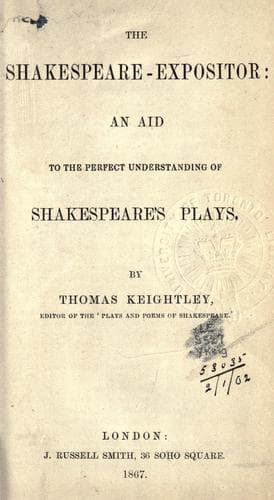
The Shakespeare-Expositor: An Aid to the Perfect Understanding of Shakespeare's PlaysKeightley, Thomas
General
The Shakespeare-Expositor: An Aid to the Perfect Understanding of Shakespeare's Plays
Keightley, Thomas
Drama -- Outlines, syllabi, etc.; Shakespeare, William, 1564-1616 -- Outlines, syllabi, etc.
* * * * *
SC. 3. "And to transport him in the mind he is _in_."
* * * * *
"And how shall we continue, Claudio."
Persons are not continued. Perhaps we should read 'continue _to keep_.'
* * * * *
"Ere twice the sun hath made his journal greeting
To the under generation, you shall find
Your safety manifested."
I adopt Hanmer's emendation, 'under' for 'yond' of the folio. "The
under-generation," says Mr. Dyce, "is the human race that dwells
_under_ heaven." In Timon (i. 1) we have "this _beneath-world_," _i.e._
this world under heaven.
* * * * *
"Quick, _quick_, despatch, and send the head to Angelo."
* * * * *
"By cold gradation and weal-balanc'd form."
Surely the correct reading is _well_. So also Rowe.
* * * * *
"Mark what I say, which you shall find _to be_
By every syllable a faithful verity."
* * * * *
"There to give up their power. If you can, pace your wisdom
In that good path, that I would wish it go _in_
And you shall have your bosom on the wretch."
The punctuation of the first line, which is that given by the editors,
while aiming at sense, makes it unreadable. We should read "Pace, if
you can, your wisdom." Or, retaining this line unaltered, we might in
the third line read _Then_ for 'And.' (See on M. N. D. ii. 1.)
* * * * *
"I am combined by a sacred vow."
As 'combined' makes no good sense, we might read _constrained_. "But
other _vows constrain_ another course" (Marston Ant. and Mel. II. v.
6). Perhaps the word was _confined_, in the sense of limited, held in.
* * * * *
SC. 4. "How might she tongue me! Yet reason dares her no;
For my authority bears of a credent bulk,
That no particular scandal once can touch,
But it confounds the breather."
There is evidently something wrong here. What is the meaning of
'dares?' Mr. Singer says overawes (as larks?), and in proof of 'no'
being crying No, he quotes: "I wear a sword to satisfy the world no"
(Fletch. Chances, iii. 4). "I am sure he did it for I charged him no"
(_Id._ Wife for Month, iv. 3). In the next line Mr. Dyce reads _so_,
others _such_, for 'of.' My own decided opinion is, that in the first
line the poet wrote _saies_ (says), which of course, being written with
a long _s_ in the beginning, might easily be taken for 'dares.' 'Says
her no,' then, is forbids her, as in "Who shall say me Nay?" (1 H. IV.
iii. 1); "God defend his Grace should say us Nay" (Rich. III. iii. 7);
and in this play (ii. 2), "Did I not tell thee Yea?" In the second line
I would omit 'of.' See on Rich. II. v. 1; Cymb. iii. 5.
* * * * *
"Might in the time to come have ta'en revenge
By so receiving," etc.
Public-domain text, read in full here on John Shaqi.
Reviews
Reviews
No reviews yet
Be the first to share your thoughts on this work.
Elsewhere in the archive
Join the Discussion
Join the discussion
Sign in to leave a comment or review.
Sign InorCreate an account