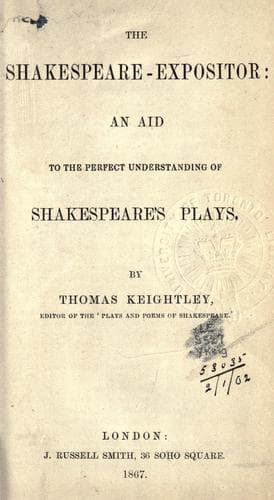
The Shakespeare-Expositor: An Aid to the Perfect Understanding of Shakespeare's PlaysKeightley, Thomas
General
The Shakespeare-Expositor: An Aid to the Perfect Understanding of Shakespeare's Plays
Keightley, Thomas
Drama -- Outlines, syllabi, etc.; Shakespeare, William, 1564-1616 -- Outlines, syllabi, etc.
Grey proposed _Charm_ for 'Clamour,' and in Othello (v. 2) we have
the very phrase, "charm your tongue." But, as far as I have observed,
_charm_ in this sense is used only by characters of the educated
class. Singer says 'clamour' here is a mere corruption of _chamour_,
_chaumer_, or _chaumbre_, from the French _chômer_, 'to refrain,'
and he adds, "Mr. Hunter has cited a passage from Taylor, the
water-poet, in which the word was thus again perverted:--'_Clamour_ the
promulgation of your tongue.'" For my own part I think that, except in
orthography, the text is right. The real word was probably _clammer_
or _clemmer_, the same as the simple _clam_ or _clem_, to squeeze or
press, and the phrase answers to _Hold your tongues_. "To _clam_ a
bell," says Johnson, "is to cover the dapper with felt, which drowns
the blow and hinders the sound." As for the extract from Taylor, I
attach little importance to it, as he probably adopted the word from
this very passage. See on Rom. and Jul. iii. 3.
* * * * *
"Why, sir, they stay at door."
The folio places 'sir' at the end of the speech; but the metre requires
the transposition, which also makes the reply run more naturally. I
neglected to make it in my Edition.
* * * * *
"Can he speak? hear?
Know man from man? dispute his own estate?"
In Romeo and Juliet (iii. 3) we have, "Let me dispute with thee of thy
estate;" but in Jonson's Fox, iii. 2,
"Read you the principles, argued all the grounds,
Disputed every fitness, every grace."
* * * * *
"Far than Deucalion off."
'Far' is an old form for _farther_, as _near_ is of _nearer_. (See
Rich. II. iii. 2, v. 1.) We need not then read _farther_, nor, with
Johnson, 'Far _as_.'
* * * * *
"Or hoop his body more with thy embraces."
The folio has 'hope,' the orthography of the time.
* * * * *
"Looks on _it_ alike. Will't please you, sir, begone?"
* * * * *
"To die upon the bed my father died _on_."
* * * * *
"And most opportune to our need I have."
For 'our' the folio reads _her_, probably from the preceding line.
Theobald made the correction.
* * * * *
"His welcomes forth; asks thee, the son, forgiveness."
The folio has _there_ for 'the.' The correction was made in the 3rd
folio.
* * * * *
"She is as forward of her breeding as
She's in the rear _of_ our birth."
* * * * *
"And then your blood had been the dearer by I know _not_ how much
an ounce."
Hanmer added the negative.
* * * * *
"Besides the King to effect your suits, here is _the_ man shall do."
ACT V.
Public-domain text, read in full here on John Shaqi.
Reviews
Reviews
No reviews yet
Be the first to share your thoughts on this work.
Elsewhere in the archive
Join the Discussion
Join the discussion
Sign in to leave a comment or review.
Sign InorCreate an account