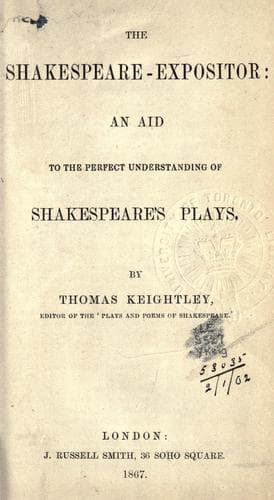
The Shakespeare-Expositor: An Aid to the Perfect Understanding of Shakespeare's PlaysKeightley, Thomas
General
The Shakespeare-Expositor: An Aid to the Perfect Understanding of Shakespeare's Plays
Keightley, Thomas
Drama -- Outlines, syllabi, etc.; Shakespeare, William, 1564-1616 -- Outlines, syllabi, etc.
SC. 1. "Just as you left them. All _are_ prisoners, sir."
* * * * *
"A solemn air and the best comforter
To an unsettled fancy cure thy brains, _that_,
Now useless, boil within thy skull."
It is better, I think, to correct thus than, with the editors, to read
'boil_'d_.'
* * * * *
"My true preserver, and a loyal sir
To him thou followest."
"That _sir_ that serves and seeks for gain."
Lear, ii. 4.
"A lady to the worthiest _sir_ that ever
Country call'd his."
Cymb. i. 7.
Still I think that the final syllable of _servant_ may have been
effaced.
* * * * *
"You, brother mine that entertain ambition."
This is the reading of the folio, and I see no need of reading with
editors 'entertain_'d_.'
* * * * *
"That yet looks on me, or would know me."
With Collier's folio I read _e'er_ for 'or.'
* * * * *
"How thou hast met us here, whom three hours since
Were wrack'd upon this shore."
This is a remarkable instance of the use of _whom_ for _who_ in the
nominative. See W. Tale, _ad fin_.
* * * * *
"Where we in all our trim freshly beheld
Our royal, good, and gallant ship."
For 'our' in the first line we must of course read _her_ with Thirlby
and Theobald. It was probably caused by the 'Our' of the next line; but
from similarity of pronunciation _our_ is sometimes confounded with
_her_ and _a_.
* * * * *
"Ever in a dream were we divided from them."
For 'them' we should perhaps read _her_.
* * * * *
"This is a strange thing as e'er I look'd on."
With Capell I read '_as_ strange a.' We have just had
"This is as strange a maze as e'er men trod."
* * * * *
"That is thy charge; then to the elements."
I confidently read 'element,' that is air, his return to which had been
already promised him.
HISTORIES.
KING JOHN.
ACT I.
SC. 1. "It would not be Sir Nob in any case."
The 2nd folio properly read _I_ for 'It.'
* * * * *
"Kneel thee down Philip, but _to_ rise more great."
* * * * *
"'Tis too respective and too sociable
For your conversion."
In the only other place where 'conversion' occurs in these plays it
signifies change; but it may be conversation.
"As at his next _conversion_ with your Grace
He will relate the circumstance at full."
Ham. 1603.
* * * * *
"Sir Robert could do well; marry, to confess _the truth_;
Could _he_ get me? Sir Robert could not do it."
ACT II.
Public-domain text, read in full here on John Shaqi.
Reviews
Reviews
No reviews yet
Be the first to share your thoughts on this work.
Elsewhere in the archive
Join the Discussion
Join the discussion
Sign in to leave a comment or review.
Sign InorCreate an account