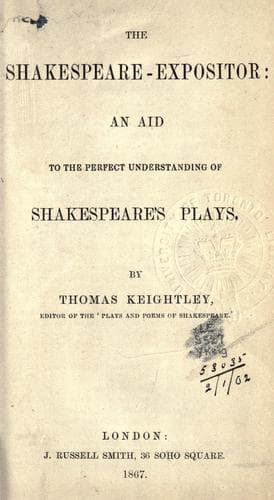
The Shakespeare-Expositor: An Aid to the Perfect Understanding of Shakespeare's PlaysKeightley, Thomas
General
The Shakespeare-Expositor: An Aid to the Perfect Understanding of Shakespeare's Plays
Keightley, Thomas
Drama -- Outlines, syllabi, etc.; Shakespeare, William, 1564-1616 -- Outlines, syllabi, etc.
For 'broom' Hanmer read _brown_, which I have adopted; though contrary
to my rule (see Introd. p. 51), as I have met no earlier authority for
this use of _brown_ than Milton. The poet's word may have been _broad_
or _trim_. The broom never attains a height to justify the terming it
a 'grove.' Dyer, a good authority, has in his Fleece "_low-tufted_
broom," and Bloomfield (Rural Tales) "_tufts_ of green broom," both
using the proper term. I doubt if 'grove' is ever used of any but
forest-trees.
* * * * *
"Spring come to you at the farthest,
In the very end of harvest."
No one has ever made, or can make, sense of this. For 'Spring'
Collier's folio reads _Rain_--no great improvement. The fact is, as
the context plainly shows, that the poet's word was _Shall_. With this
simple change the whole passage becomes clear and grammatical, and
forms a parallel to the fairy-blessing at the end of Mids. Night's
Dream.
* * * * *
"So rare a wonder'd father and a wise."
Some copies of the folio read 'wife' for 'wise'; which has become the
general reading, even that of the Cambridge Edition. I prefer, as
more Shakespearian, the other reading, which is also that of all the
succeeding folios.
* * * * *
"Makes this place paradise--_O_ sweet, now silence."
* * * * *
"You nymphs, called Naiads of the winding brooks,
With your sedg'd crowns and ever harmless looks."
The word in the folio is _windring_; so it is doubtful whether we
should read _winding_ or _wandering_. 'Sedg'd' may have been _sedge_;
for the sound is exactly the same in this place.
* * * * *
"You do look in a mov'd sort, my son."
The folio reads "my son, in a moved sort."
* * * * *
"Leave not a wrack behind."
This is undoubtedly the true reading. The folio has _racke_, but
instances of this error are common. See my note on Milton's Par. Reg.
iv. 452. We have _wrack_ for _rack_ in
"Even like a man new-haled from the _wrack_."
1 Hen. VI. ii. 5.
* * * * *
"Humanly speaking all, all lost, quite lost."
With Malone, I read _are_ for the second 'all.' In the same way we have
"sir, sir," in All's Well, v. 2.
* * * * *
"_O_ good my lord, give me thy favour still."
* * * * *
"Let us alone,
And do the murder first."
With Theobald I read 'Let us along,' which connects so well with what
follows: we have this very expression in Wint. Tale, v. 2; and see on
L. L. L. iv. 3. Hanmer read 'Let _it_ alone.'
* * * * *
"Make us strange stuff ..."
* * * * *
"_Hey_, Fury, Fury! there, Tyrant, there! hark, hark!"
ACT V.
Public-domain text, read in full here on John Shaqi.
Reviews
Reviews
No reviews yet
Be the first to share your thoughts on this work.
Elsewhere in the archive
Join the Discussion
Join the discussion
Sign in to leave a comment or review.
Sign InorCreate an account