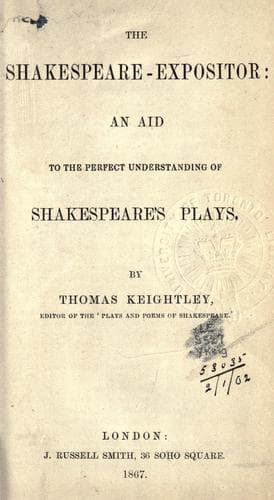
The Shakespeare-Expositor: An Aid to the Perfect Understanding of Shakespeare's PlaysKeightley, Thomas
General
The Shakespeare-Expositor: An Aid to the Perfect Understanding of Shakespeare's Plays
Keightley, Thomas
Drama -- Outlines, syllabi, etc.; Shakespeare, William, 1564-1616 -- Outlines, syllabi, etc.
"Stay _them_; the King hath thrown his warder down."
* * * * *
"To wake our Peace, which in our country's cradle," etc.
From what follows, in which she is said to "fright fair Peace," we
might suspect that for 'Peace' the poet had written _Strife_, or some
such word.
* * * * *
"The sly slow hours shall not determinate."
Pope read _fly_, and he has been generally followed. I have little
doubt that the poet wrote _slide_ (_i. q._ glide) _slow_.
"So sholdestow endure and latten _slyde_
The _tyme_ and fonde to be glad and light."
Chauc. Tr. and Cress.
In Albumazar we have, "How _slow_ the day _slides_ on!" The _d_ was not
sounded in _slide-slow_. Introd. p. 52.
* * * * *
"It boots thee not to be compassionate."
Theobald proposed 'become passionate'; Singer 'be so passionate.' No
change seems to be needed, though the expression is singular.
* * * * *
"To plot, contrive, or complot any ill."
It might be better to read _compass_ for 'complot,' as the preceding
'plot' may have been in the printer's mind; or _plan_ for 'plot.'
* * * * *
"Norfolk, so fare as to mine enemy...."
There is here, I think, an aposiopesis, which removes all difficulty;
_far_ is usually read for 'fare,' the reading of the 4tos and folio.
* * * * *
"_Wherefore_ think not the king did banish thee."
* * * * *
SC. 4. "We did observe _it_. Cousin Aumerle."
* * * * *
"Where lies he?--At Ely-house, _my lord_."
By reading 'where' a dissyllable, and thus throwing a metric accent
on 'he,' we have the expression of the proud unfeeling character of
Richard in the early part of the play. Propriety--to say nothing of
metre--demands _my lord_.
ACT II.
SC. 1. "The setting sun, and music at the close,
As the last taste of sweets, is sweetest last,
Writ in remembrance more than things long past."
So this place is pointed in the original and subsequent editions,
making little or no sense. I punctuate--'As the last taste of sweets
is sweetest--last'; in which I find I had been anticipated by Mason.
The passage is one of the poet's obscurest. His meaning is that the
concluding part of any impression on the senses is the most permanent
in its effect on the mind; but how strangely expressed!
* * * * *
"As praises of his state. Then there are found
Lascivious metres," etc.
The two earliest 4tos read: "As praises, of whose taste the wise are
_found_;" and by reading, as we should, _fond_, this also gives us very
good sense.
* * * * *
"Against the envy of less happier lands."
Public-domain text, read in full here on John Shaqi.
Reviews
Reviews
No reviews yet
Be the first to share your thoughts on this work.
Elsewhere in the archive
Join the Discussion
Join the discussion
Sign in to leave a comment or review.
Sign InorCreate an account