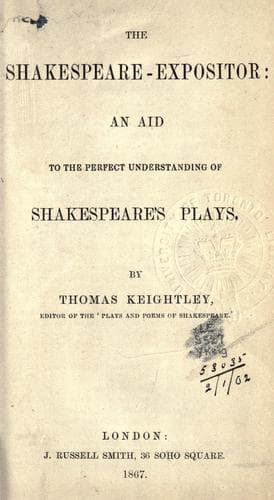
The Shakespeare-Expositor: An Aid to the Perfect Understanding of Shakespeare's PlaysKeightley, Thomas
General
The Shakespeare-Expositor: An Aid to the Perfect Understanding of Shakespeare's Plays
Keightley, Thomas
Drama -- Outlines, syllabi, etc.; Shakespeare, William, 1564-1616 -- Outlines, syllabi, etc.
Pope read _happy_, which is doubtless more grammatical, according to
the language of later times; but the text is probably as the poet wrote
it. See on As You Like it, i. 2.
* * * * *
"For young hot colts being rag'd do rage the more."
There seems hardly to be any doubt that 'rag'd,' to which it is
impossible to give any tolerable meaning, was suggested by 'rage.' We
might read _curb'd_ or, with Ritson, _rein'd_, as in Cor. iii. 3.
* * * * *
"I do beseech your majesty, impute
His words to wayward sickliness and age."
So I read, omitting 'in him,' introduced by the printer, at the end of
the second line.
* * * * *
"What says he _now_?--Nay, nothing; all is said."
* * * * *
"Or else he never would compare between _you_."
* * * * *
"Tends that _that_ thou would'st speak to the Duke of Hereford?"
* * * * *
"And quite lost their hearts; the nobles hath he fin'd,
For ancient quarrels, and quite lost their hearts _too_."
* * * * *
"Thy words are but as thoughts; therefore be bold."
Collier's folio needlessly reads _Our_ for 'Thy.'
* * * * *
"That Harry Duke of Hereford, Reginald lord Cobham,
That late broke from the Duke of Exeter,
His brother, late Archbishop of Canterbury."
From Malone's note it would seem quite plain that a line has been lost
after the first; yet the poet may have fallen into error. The person
who escaped was Thomas Arundel, the nephew, not the brother, of the
'late archbishop.' I transpose here in agreement with the text of
Holinshed and the laws of metre.
* * * * *
SC. 2. "Thus thrust disorderly into my hands."
The 4tos and folio read 'Thus disorderly thrust.'
* * * * *
"Is my _near_ kinsman, whom the king hath wronged."
* * * * *
"The hateful commons will perform for us."
The 4tos and folio read "Will the hateful," etc.
* * * * *
SC. 3. "To take advantage of the absent time."
It means probably of the time of absence; but it is very awkwardly
expressed. Perhaps for 'time' we should read _king_, which Theobald
also proposed. We have "the absent King" (_i.e._ Rich. II.) in 1 Hen.
IV. iv. 3.
* * * * *
"And ostentation of despised arms."
I can see no sense in 'despised' here; Singer reads _disposed_. I
prefer _displayed_, which he also had conjectured.
* * * * *
SC. 4. "The other _in hope_ to enjoy by rage and war."
So also Theobald completed sense and metre.
ACT III.
SC. 1. "Thanks, gentle uncle. Come, _my_ lords, away,
To fight with Glendower and his complices."
Public-domain text, read in full here on John Shaqi.
Reviews
Reviews
No reviews yet
Be the first to share your thoughts on this work.
Elsewhere in the archive
Join the Discussion
Join the discussion
Sign in to leave a comment or review.
Sign InorCreate an account