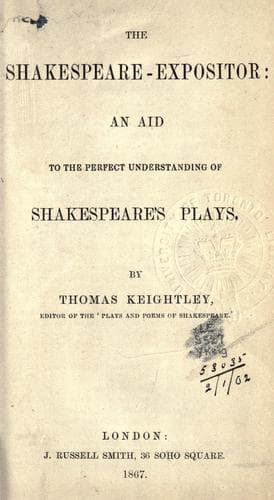
The Shakespeare-Expositor: An Aid to the Perfect Understanding of Shakespeare's PlaysKeightley, Thomas
General
The Shakespeare-Expositor: An Aid to the Perfect Understanding of Shakespeare's Plays
Keightley, Thomas
Drama -- Outlines, syllabi, etc.; Shakespeare, William, 1564-1616 -- Outlines, syllabi, etc.
The explanations given of 'Balk'd' do not satisfy me. Steevens has
given some good authority for _Bak'd_, the conjecture of Grey; but
on the whole I incline to Heath's _Bath'd_. Still I have made no
alteration.
* * * * *
"Mordake, _the_ earl of Fife, and eldest son
To beaten Douglas, and the earls of Athol,
Of Murray, _and_ of Angus and Menteith."
* * * * *
SC. 2. "If thou darest not stand for ten shillings."
Pope also read, as I do, '_cry_ stand.'
* * * * *
SC. 3. "And you have found me; for accordingly
You tread upon my patience."
I read 'have found me _so_. Accordingly.' In Com. of Err. i. 1. and
elsewhere we have _so_ for _for_.
* * * * *
"I will from henceforth rather be myself,
Mighty and to be fear'd, than my condition."
What is the difference between 'myself' and 'my condition,' _i.e._
natural disposition? I read 'my condition _past_.'
* * * * *
"Out of my grief and my impatience
To be so pestered with a popinjay."
So Edwards and Johnson properly transposed these lines.
* * * * *
"Art thou not ashamed? But, sirrah, _from_ henceforth."
* * * * *
"By Richard that dead is, the next of blood."
It is so printed in both 4tos and folio; but we surely should read 'is
dead.'
* * * * *
"As to o'erwalk a current roaring loud."
Perhaps the poet used the more forceable term, _torrent_.
* * * * *
"But not the form of what he should attend _to_."
* * * * *
"Tying thine ear to no tongue but thine own."
Perhaps 'Tying' was not the poet's word. It may have been _Turning_, or
some other.
* * * * *
"Will easily be granted. You, my lord," etc.
Such is the proper punctuation, also proposed by Thirlby.
* * * * *
"I'll steal to Glendower and Lord Mortimer."
There is evidently a line lost after this.
ACT II.
SC. 1. "But with nobility and tranquillity."
To all appearance, _gentility_ would be more correct; but he may be
playing on the ignorance of the Chamberlain, to whom the word was
unknown. He then says 'great-onyers' for great-ones.
* * * * *
SC. 2. "Away, good Ned. _Fat_ Falstaff sweats to death."
So also Capell.
* * * * *
SC. 3. "One horse, my lord, he _hath_ brought even now."
* * * * *
SC. 4. "Ned, prythee come out of that fat room."
I suspect we should read _hot_ room.
* * * * *
"Pitiful-hearted Titan, that melted at the sweet tale of the son's."
Public-domain text, read in full here on John Shaqi.
Reviews
Reviews
No reviews yet
Be the first to share your thoughts on this work.
Elsewhere in the archive
Join the Discussion
Join the discussion
Sign in to leave a comment or review.
Sign InorCreate an account