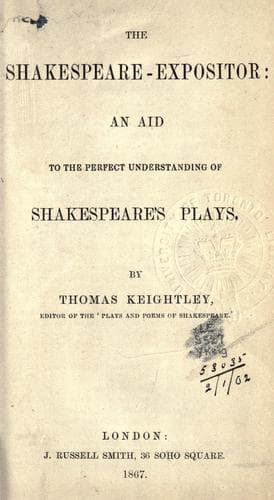
The Shakespeare-Expositor: An Aid to the Perfect Understanding of Shakespeare's PlaysKeightley, Thomas
General
The Shakespeare-Expositor: An Aid to the Perfect Understanding of Shakespeare's Plays
Keightley, Thomas
Drama -- Outlines, syllabi, etc.; Shakespeare, William, 1564-1616 -- Outlines, syllabi, etc.
So I read, with the two earliest 4tos; the others and the folio have
_sun_ for 'son's'; and, with Malone, I see a reference to the Tale of
Phaethon. Of the double genitive there are many instances. Theobald,
who is followed by Singer, read _butter_ for 'Titan,' thinking there
was an incongruity. But the Prince, in the exuberance of his spirits,
spoke rather at random, heedless of the unconnectedness of his
discourse.
* * * * *
"If thou didst, then behold that compound."
It may be that _never_ has been omitted before 'didst.'
* * * * *
"Away, you starveling, you elf-skin."
Hanmer and Warburton were right, I think, in reading _eel_ for 'elf.'
* * * * *
"You dried neat's tongue, _you_ bull's pizzle, you stock-fish."
* * * * *
"There is virtue in that Falstaff; him keep with."
The poet probably wrote 'him keep with _thee_.'
* * * * *
"Misleader of youth, Falstaff, that old, white-bearded Satan."
It would be better, both for emphasis and metre, to read '_that_
Falstaff.'
ACT III.
SC. 1. "The arch-deacon hath divided it _for us_."
* * * * *
"And then he runs _you_ straight and even_ly_."
* * * * *
"I'll _in and_ haste the writer and withal."
So I think we should read with Steevens and Malone. "I'll in, to urge
his hatred more to Clarence" (Rich. III. i. 1).
* * * * *
"He held me last night at _the_ least nine hours."
* * * * *
"As a tired horse or _as a_ railing wife."
So Pope also. The usual correction is that of Capell, 'as _is_ a tired
horse.'
* * * * *
"In faith, my lord, you are too wilful-blame_able_."
We have "wilful-opposite" (K. John, v. 2), "wilful-negligent" (Wint.
Tale, i. 2), "wilful-slow" (Son. li.), and "wilful-ignorant" (Fletcher,
Woman-hater, v. 2). For my part, I regard it as a convincing proof of
the truth of my theory of effacement (Introd. p. 57).
* * * * *
"Which thou pourest down from those swelling heavens."
The Cambridge editors and myself have independently transposed in
'pourest down.' We might also read "Which from those," etc.
* * * * *
"Nay, _nay_, if you melt, then will she run mad."
* * * * *
"Come, Kate, _come_; thou art perfect in lying down."
* * * * *
"I had rather hear Lady, my brach, howl in Irish."
So, after all the editors, I have printed it, in accordance with the
4tos; the folio applies 'Lady' to Lady Percy. I, however, strongly
suspect that we should read 'my lady-brach,' as in Lear, i. 4, which
would also accord better with the metre. See Index _s. v_. Brach.
Public-domain text, read in full here on John Shaqi.
Reviews
Reviews
No reviews yet
Be the first to share your thoughts on this work.
Elsewhere in the archive
Join the Discussion
Join the discussion
Sign in to leave a comment or review.
Sign InorCreate an account