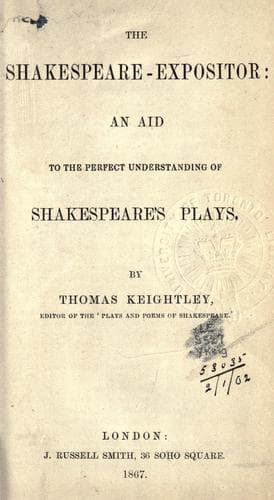
The Shakespeare-Expositor: An Aid to the Perfect Understanding of Shakespeare's PlaysKeightley, Thomas
General
The Shakespeare-Expositor: An Aid to the Perfect Understanding of Shakespeare's Plays
Keightley, Thomas
Drama -- Outlines, syllabi, etc.; Shakespeare, William, 1564-1616 -- Outlines, syllabi, etc.
* * * * *
"Come sing.--I will not sing.--'Tis the next way
To turn tailor or be redbreast-teacher."
So it should be arranged.
* * * * *
"By this our book is drawn; we'll but seal and then
To horse immediately. With all my heart."
As this is preceded by a couplet, and the scenes generally end with
one, I would read 'then _start'_ for 'and then.' _Start_ being probably
effaced, the printer added 'and' to complete the measure. See Introd.
p. 67.
* * * * *
SC. 2. "As in reproof of many tales devis'd--
Which oft the ear of Greatness needs must hear--
By smiling pick-thanks and base news-mongers."
The two last lines should, I think, be transposed.
* * * * *
"Mingled his royalty with carping fools."
The 4to, 1598, reads _capring_, i.e. capering. The choice is difficult.
* * * * *
SC. 3. "Go, Poins, to horse, to horse!"
Both 4tos and folio have _Peto_. Johnson made the change.
* * * * *
"At two o'clock in the afternoon."
Something seems wanting here. I have added _precisely_.
ACT IV.
SC. 1. "He writes me hëre that _an_ inward sickness."
* * * * *
"It were not good; for therein should we read
The very bottom and the soul of hope."
I can make no sense of 'read'; we might read _reach_.
* * * * *
"All plum'd like estriches that with the wind _are fann'd_."
It is plain that something has been lost here; it may be a line, but
I think the slight addition I have made, and in the very place where
the loss was most likely to occur, removes all difficulty. "The air
of Paradise did _fan_ the house" (All's Well, iii. 2). The poet had
in his mind the Prince's plume, which he supposes to have been worn
by his companions also; and it is quite evident--or else there is no
force in the comparison--that he also supposed that it was on his head
the ostrich carried his long bending feathers. So Drayton also: "The
Mountfords all in plumes, like ostriches were seen" (Polyolb. xxii.).
The following line of Tasso gives us the exact image:--"E _ventolar_
sui gran cimier le penne" (Ger. Lib. xx. 28). Hanmer read '_and_ with
the wind.' Rowe, who has been generally followed, read _wing_ for
'with'; but the verb _wing_ has but one sense in the poets, to fly, and
the ostrich no more flies than the greyhound. Mr. Dyce, however, adopts
this reading, which, he says, "affords a clear and good meaning," and
he quotes in support of it these lines of Claudian, who, he thinks may,
as a native of Egypt, be speaking as an eye-witness:--
Public-domain text, read in full here on John Shaqi.
Reviews
Reviews
No reviews yet
Be the first to share your thoughts on this work.
Elsewhere in the archive
Join the Discussion
Join the discussion
Sign in to leave a comment or review.
Sign InorCreate an account