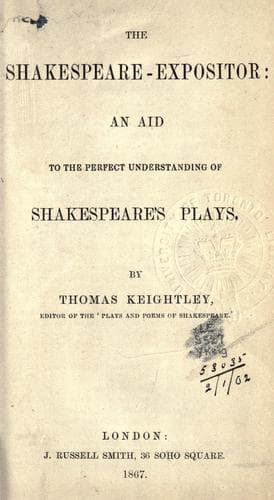
The Shakespeare-Expositor: An Aid to the Perfect Understanding of Shakespeare's PlaysKeightley, Thomas
General
The Shakespeare-Expositor: An Aid to the Perfect Understanding of Shakespeare's Plays
Keightley, Thomas
Drama -- Outlines, syllabi, etc.; Shakespeare, William, 1564-1616 -- Outlines, syllabi, etc.
I make this insertion with confidence; for this is the only speech in
this play beginning with a short line not complementary to the end of
a preceding speech. In our poet's plays of this period speeches never
began with a short line, unless when complementary, and at no time was
the second line of a couplet short. (Introd. p. 82.) Lower down (i. 5)
we have "Content thee, _gentle coz_, let him alone," where the 4to,
1597, omits all but "let him alone."
* * * * *
"Being vexed, a sea nourish'd with lover's tears."
As Johnson also saw, a line is lost here.
* * * * *
"Tell me, in sadness, who she is you love."
This is the reading of 4to 1597, which, however, has 'whom' (see
Introd. p. 59). The other 4tos and the folios read "who is that you
love."
* * * * *
"But sadly tell me who _she is you love_."
These words seem evidently to have been lost; and the repetition is
very agreeable. Moreover in this play speeches do not thus end with a
short line.
* * * * *
"From Love's weak childish bow she lives unharm'd."
A correction of Rowe's for _uncharm'd_ of the originals.
* * * * *
"Only poor,
That when she dies with beauty dies her store."
The plain meaning of this is, that beauty was 'her store,' she had
nothing but it, poor praise indeed from a lover! I would read, with
Theobald,
"That when she dies with her dies beauty store."
The meaning would then be that, as the whole store of beauty lay, as
it were, in her, by not marrying and transmitting it to her children,
she would cause it to die with her, and would thus be poor as leaving
nothing after her. The same idea is expressed in the poet's first and
following sonnets: in Venus and Adonis we have--
"For he being dead, with him is beauty slain,"
and other passages of a similar nature. See also Twelfth Night, i. 5.
* * * * *
"'Tis the way
To call hers, exquisite, in question more."
This is not very intelligible. We might read 'her exquisite,' or rather
'_to_ question.' To "call in question," in Shakespeare always means, to
express a doubt of. 'Question' is examine, a word just used.
* * * * *
SC. 2. "Earth hath swallowed all my hopes but she,
She is the hopeful lady of my earth."
Here a rime is lost, in consequence of the 'earth' of the first line
being in the printer's mind. There can be little question, I should
think, that the original word was not 'earth,' but _fee_, feud, fief,
landed property, as in _knight's fee_, _in fee_, etc., with which alone
'lady' accords. '_The_ earth' has long been the reading the first line.
* * * * *
Public-domain text, read in full here on John Shaqi.
Reviews
Reviews
No reviews yet
Be the first to share your thoughts on this work.
Elsewhere in the archive
Join the Discussion
Join the discussion
Sign in to leave a comment or review.
Sign InorCreate an account