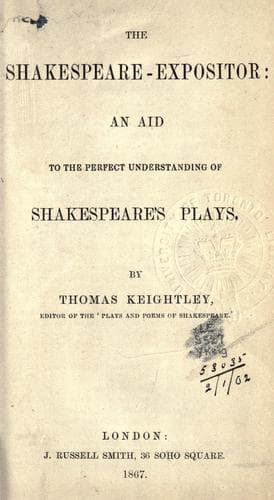
The Shakespeare-Expositor: An Aid to the Perfect Understanding of Shakespeare's PlaysKeightley, Thomas
General
The Shakespeare-Expositor: An Aid to the Perfect Understanding of Shakespeare's Plays
Keightley, Thomas
Drama -- Outlines, syllabi, etc.; Shakespeare, William, 1564-1616 -- Outlines, syllabi, etc.
Of 'runaway,' which cannot possibly be right, the Cambridge edition
enumerates no less than twenty-nine various corrections! Warburton
understood by it the sun; Steevens, the night; Douce, Juliet; and a Mr.
Halpen, Cupid. Jackson, followed by Collier, read _unawares_. Mr. Dyce
conjectured _roving_, _soon day's_, and _rude day's_, which last he
has placed in the text, but which seems to me to be too young-ladyish
for the ardent and _naïve_ Juliet; and moreover she had already called
for the winking of day's eye, _i.e._ for sunset. Some sense might also
be made of _runagates_, as persons wandering about by night, and still
better of _runabouts_, a word used by Marston (What you Will, iii. 1),
and which I have placed in the text, as making tolerable sense and
bearing resemblance to 'runaways.' Mr. Singer read _rumourers_, against
which little objection can be made. My own opinion--to which I was
led by Singer's reading, and in which I find I had been anticipated
by Heath and Mr. Grant White--is, that the poet's word may have been
_Rumour's_. In the poem on which this play is founded, Juliet, when
pondering, before her marriage, on what might be the consequence of
admitting Romeo to a lover's privilege, says:--
"So, I defil'd, _Report_ shall take her trump of black defame,
Whence she, with puffed cheek, shall blow a blast so shrill
Of my dispraise, that with the noise Verona she shall fill."
Now Shakespeare may have wished to preserve this imagery, and have
substituted _Rumour_ for _Report_ for euphony's sake and other causes.
Rumour in effect seems to have been the same as the classic Fame. In
Sir Clyomen and Sir Clamydes, a piece with which he was probably well
acquainted, we meet "Enter Rumour running," and this may have been in
his mind when he was writing the Induction to 2 Hen. IV. In his other
plays also he personifies both _rumour_ and _report_, as in
"That pitiful Rumour may report my flight,
To consolate thine ear. Come night, end day;
For with the dark, poor thief, I'll steal away."
All's Well, iii. 2.
He may also have had these lines of Phaer's Virgil in his mind:--
"At night she [Fame] walks, nor slumber sweet doth take nor never
sleeps,
By day on houses' tops she sits, and gates or towers she keeps,
On watching-towers she climbs, and cities great she makes aghast,
Both truth and falsehood forth she tells, and lies abroad doth cast."
We may, then, fancy Juliet to suppose that Rumour was on the watch to
detect and expose her, and she wishes that the gloom may be so intense
that her eyes must wink perforce, and so Romeo may leap to her arms
unseen, and their union remain undivulged. There may also have been
intended a play on the names Rumour and Romeo, like "My conceal'd
lady to our cancell'd love" (iii. 3). As Shakespeare undoubtedly knew
French, he may have had these lines of Marot in his mind:--
Public-domain text, read in full here on John Shaqi.
Reviews
Reviews
No reviews yet
Be the first to share your thoughts on this work.
Elsewhere in the archive
Join the Discussion
Join the discussion
Sign in to leave a comment or review.
Sign InorCreate an account