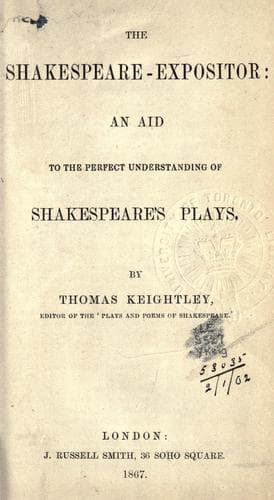
The Shakespeare-Expositor: An Aid to the Perfect Understanding of Shakespeare's PlaysKeightley, Thomas
General
The Shakespeare-Expositor: An Aid to the Perfect Understanding of Shakespeare's Plays
Keightley, Thomas
Drama -- Outlines, syllabi, etc.; Shakespeare, William, 1564-1616 -- Outlines, syllabi, etc.
"Car noire Nuict, qui des amants prend cure,
Les couvrira de sa grand robbe obscure;
Et si rendra cependant endormis
Ceux qui d'Amour sont mortelz ennemis."
Eleg. xi.
* * * * *
"Till strange Love grow bold,
Think true love acted simple modesty."
Rowe, who has been followed by all, reads 'grow_n_,' and he probably
was right. Still, when we consider the joyous perturbation of Juliet's
mind, there may be an asyndeton, and she may be speaking _allo
staccato_. I have therefore, in my Edition, left the text unaltered.
* * * * *
SC. 3. "A gentler judgement vanish'd from his lips."
I have never met with any sense of 'vanish' but its ordinary one,
which certainly will not suit here. We should therefore, I think, read
_issued_, or some word of similar meaning. It is curious that Massinger
seems to have taken 'vanish'd' on Shakespeare's authority. "Upon those
lips from which those sweet words _vanish'd_" (Reneg. v. 5). We have,
however, in Lucrece:--
"To make more vent for passage of her breath,
Which thronging through her lips, so _vanisheth_
As smoke from Ætna, that in air consumes."
But the breath is material.
* * * * *
"Taking thy part he rush'd aside the law."
Would not _push'd_ be better? as in
"But that the scambling and unquiet time
Did _push_ it out of further question."
Hen. V. i. 1.
* * * * *
"But Romeo may not: he is banished.
This may flies do, while I from this must fly;
And sayest thou yet that exile is not death?"
The folio, which gives the best text here, erroneously puts the first
of these lines after the third. The 4tos of 1599 and 1609 add most
unnecessarily:--
"Flies may do this, but I from this must fly;
They are free men, but I am banished,"
which seems to have been an earlier form of the two preceding lines.
See on L. L. L. iv. 3.
* * * * *
SC. 5. "Art thou gone so? my lord, my love, my friend."
So the first 4to, which, with Mr. Dyce, I follow. The other editions
read:--
"Art thou gone so? love, lord, ay husband, friend."
* * * * *
"Which you _do_ weep for.--Feeling so the loss."
* * * * *
"Villain and he be many miles asunder!
God pardon _him_! I do with all my heart."
Public-domain text, read in full here on John Shaqi.
Reviews
Reviews
No reviews yet
Be the first to share your thoughts on this work.
Elsewhere in the archive
Join the Discussion
Join the discussion
Sign in to leave a comment or review.
Sign InorCreate an account