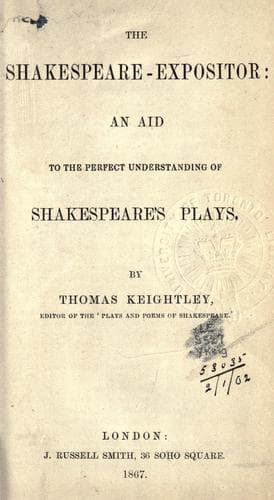
The Shakespeare-Expositor: An Aid to the Perfect Understanding of Shakespeare's PlaysKeightley, Thomas
General
The Shakespeare-Expositor: An Aid to the Perfect Understanding of Shakespeare's Plays
Keightley, Thomas
Drama -- Outlines, syllabi, etc.; Shakespeare, William, 1564-1616 -- Outlines, syllabi, etc.
"Whilst, like a willing patient, I will drink
Potions of _eysel_ 'gainst my strong infection."
Son. cxi.
and further that, by association of ideas, 'crocodile' presupposes the
mention of a river. The Yssel, a river of the Low Countries, runs by
Deventer and Zutphen, near which last place Sir Philip Sidney received
his death-wound, and so the name Yssel may have been familiar to the
English mind. I therefore have placed it in the text.
* * * * *
"_In_ an hour of quiet thereby shall we see."
* * * * *
SC. 2. "_I_ folded up the writ in form of the other."
* * * * *
"For by the image of my cause I see
The portraiture of his. I'll count his favours."
It is best to read, with Rowe, 'I'll _court_ his favour.'
* * * * *
"You will do it, sir, really."
I incline to read _readily_.
* * * * *
"And yet but yaw neither."
So 4to 1604. The others have _raw_.
* * * * *
"The most _fond_ and winnowed opinions."
I quite agree with those who read _fann'd_.
* * * * *
"_As_ that I have shot an arrow o'er the house."
* * * * *
"Stick fiery off indeed."
In my Edition I most rashly read _Strike_ for 'Stick.' In the language
of the time _stick off_ meant set off, show off, display:--
"Nor virtue shines more in a lovely face,
Than true desert is _stuck off_ with disgrace."
Chapman, Dedic. of Batrach., etc.
"His lute still touch'd to _stick_ more _off_ his tongue."
Id. Hymn to Hermes, 766.
Yet Chapman, in whom alone I have found it, may have adopted it from
one of the 4tos of this play. See on Rom. and Jul. iii. 3.
* * * * *
"I do not fear it; I have seen you both.--
But since he's better'd, we have therefore odds."
If he (_i.e._ Laertes) was bettered, in the ordinary sense of the
word, how could the odds lie against him? _You're_ would give better
sense than 'he's'; but it does not satisfy me. A line has evidently
been lost, and the latter part may be addressed to the Queen. The lost
line may have been something like this: "'Tis true he did neglect his
exercises." Hamlet had said (ii. 2) he had "foregone all custom of
exercises." In my Edition I have made an _Aside_ here to the Queen, who
may have made a sign of dissent; but a speech of the Queen's to the
same effect may have been what is lost.
* * * * *
"Come.--Another hit.--What say you?
[A touch a touch] I do confess."
With the 4tos I omit the bracketed words, as needless to the sense and
injurious to the measure.
* * * * *
Public-domain text, read in full here on John Shaqi.
Reviews
Reviews
No reviews yet
Be the first to share your thoughts on this work.
Elsewhere in the archive
Join the Discussion
Join the discussion
Sign in to leave a comment or review.
Sign InorCreate an account