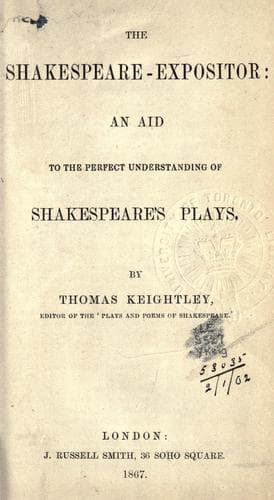
The Shakespeare-Expositor: An Aid to the Perfect Understanding of Shakespeare's PlaysKeightley, Thomas
General
The Shakespeare-Expositor: An Aid to the Perfect Understanding of Shakespeare's Plays
Keightley, Thomas
Drama -- Outlines, syllabi, etc.; Shakespeare, William, 1564-1616 -- Outlines, syllabi, etc.
"_I'_ the interim having weigh'd it."
The _I'_ is not absolutely necessary, but I think Shakespeare wrote it.
See on Hamlet, iii. 1.
* * * * *
SC. 4. "Is execution done on Cawdor? or not
Those in commission yet returned?"
There is every reason to suppose that the poet wrote '_are_ not,' the
reading of the 2nd folio.
* * * * *
SC. 5. "That which cries "Thus must thou do, if thou'_dst_ have it."
* * * * *
"The raven himself is hoarse
That croaks the fatal enterance of Duncan
Under my battlements. Come you spirits."
It is strange that our critics have not seen that the raven is
figurative, and means the man. I find that the German Delius had also
perceived it. In the third line I think we should read 'spirits of
_evil_'; for a foot is wanting, and good as well as evil spirits 'tend
on mortal thoughts.' The ordinary correction, 'Come, _come_,' is a mere
make-shift, and is tame and feeble.
* * * * *
"And take my milk for gall."
Perhaps we should read _with_ for 'for,' taking 'take' in the sense of
tinge, infect, a sense it often bears.
* * * * *
"Nor Heaven peep through the blanket of the dark."
The word 'blanket' certainly seems too familiar and even vulgar an
expression, especially as the more dignified 'pall thee' had just
been used. Malone quotes from Drayton's Mortemeriados, 1596, "The
sullen night in misty _rug_ is wrapp'd." But even this is not so low
as 'blanket.' Collier's folio reads _blankness_, but that surely is
whiteness. Perhaps we might venture to read _blackness_, as in Ant. and
Cleop. (i. 4) we have "Night's _blackness_." At that time 'peep' was
to gaze earnestly and steadily at anything; not furtively, as now. 'To
cry' in the next line may be crying. See Introd. p. 70.
* * * * *
SC. 6. "By his loved mansionry that the heaven's breath
Smells wooingly here; no jutty, frieze,
Buttress, nor coign of vantage, but this bird _on't_
Hath made his pendent bed and procreant cradle."
The second line here is short by a foot; and as it does not end a
paragraph, there must be something wrong. The defect, however, is
easily remedied; we have only to read,
"By his lov'd mansiönry that the heaven's
Breath smells wooingly here."
Public-domain text, read in full here on John Shaqi.
Reviews
Reviews
No reviews yet
Be the first to share your thoughts on this work.
Elsewhere in the archive
Join the Discussion
Join the discussion
Sign in to leave a comment or review.
Sign InorCreate an account