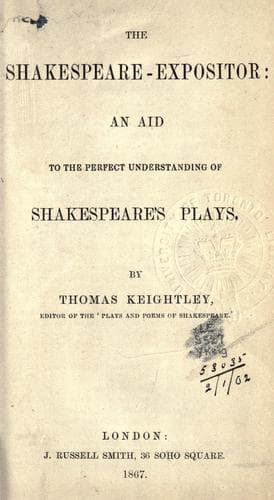
The Shakespeare-Expositor: An Aid to the Perfect Understanding of Shakespeare's PlaysKeightley, Thomas
General
The Shakespeare-Expositor: An Aid to the Perfect Understanding of Shakespeare's Plays
Keightley, Thomas
Drama -- Outlines, syllabi, etc.; Shakespeare, William, 1564-1616 -- Outlines, syllabi, etc.
The structure of the last line is like that of "Thy knee bussing the
stones" (Cor. iii. 1). "The mind is its own place" (Par. Lost, i. 254),
and similar places. There can be little doubt, I think, that _on't_
was effaced at the end of the third line; for the poet could hardly,
even in his most careless moment, have termed solid parts of a building
'pendent nests,' etc. Wordsworth, with this very place in his mind,
wrote: "_On_ coigns of vantage _hang_ their nests of clay" (Misc. Son.
34). It is also in favour of this reading that it throws the metric
accent on _this_, thereby adding force. 'Coign of vantage' would seem
to be _coin d'avantage_, Fr., and denoting a projection of some kind.
* * * * *
SC. 7. "If it were done when 'tis done then 'twere well
It were done quickly. If the assassination
Could trammel up the consequence, and catch
With his success surcease; that but this blow
Might be the be-all and the end-all here;
But here--upon this bank and shoal of time--
We'd jump the life to come.... But in these cases," etc.
So the passage should be pointed. The first 'done' in the first
line is, finished, ended; from 'If' in the second line to 'life to
come' in the seventh is one sentence, with the same idea repeated in
three several forms, and not completed; common sense dictates the
transposition of 'surcease' and 'success,' the latter signifying
accomplishment; 'but' in lines four and six is, only; 'the life to
come' is not the future state but the remaining years of his own life,
as is manifest from what follows. In scene 5 we have had, "Which shall
to all our _nights and days to come_." We also meet with, "True swains
in love shall in the _world to come_" (Tr. and Cr. iii. 2). "Thus all
his _life to come_ is loss and shame." Cowley, Davideis, ii. 616.
* * * * *
"Vaulting ambition which o'erleaps itself,
And falls on the other _side_.--How now! what news?"
Hanmer also supplied _side_, which metre and sense demand alike. He
had completed what he intended to say, and was pausing when his wife
entered.
* * * * *
"At what it did so freely? From this time
Such I account thy love."
A line or more must have been lost between these lines.
* * * * *
"I dare do all that may become a man;
Who dares do more is none."
For 'do' in the second line, the correction of Southern and Rowe,
generally adopted, the folio has _no_, which Mr. Hunter retains, giving
the line to Lady Macbeth. But her reply, "What _beast_ was it then?"
shows that _do_ was the poet's word.
ACT II.
SC. 1. "Sent forth great largess to your officers."
Public-domain text, read in full here on John Shaqi.
Reviews
Reviews
No reviews yet
Be the first to share your thoughts on this work.
Elsewhere in the archive
Join the Discussion
Join the discussion
Sign in to leave a comment or review.
Sign InorCreate an account