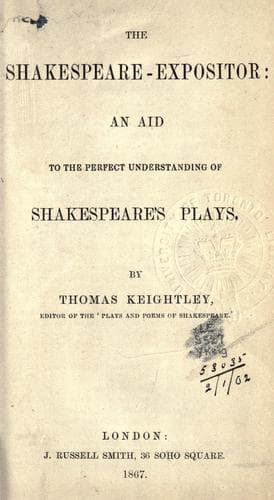
The Shakespeare-Expositor: An Aid to the Perfect Understanding of Shakespeare's PlaysKeightley, Thomas
General
The Shakespeare-Expositor: An Aid to the Perfect Understanding of Shakespeare's Plays
Keightley, Thomas
Drama -- Outlines, syllabi, etc.; Shakespeare, William, 1564-1616 -- Outlines, syllabi, etc.
A syllable is wanting; we have "_most_ worst" in Winter's Tale, iii. 2,
and double comparatives and superlatives are common.
* * * * *
SC. 2. "Whom we to gain our peace have sent to peace."
The first 'peace' was probably suggested, in the usual manner, by the
second. We might read _seat_, or some such word (see Introd. p. 64).
The 2nd folio has _place_.
* * * * *
"Cancel and tear to pieces that great bond."
We should read _band_, riming with 'hand.'
* * * * *
"Light thickness and the crow
Makes wing to the rooky wood. * * *"
We might add, _on earth below_. We have, "In all designs begun _on
earth below_" (Tr. and Cr. i. 3).
* * * * *
"Things bad begun make strong themselves by ill."
It might be better to read 'themselves strong.'
* * * * *
SC. 4. "'Tis better thee without than he within."
The 'he' had better probably be _him_.
* * * * *
"We'll hear _thee_ ourselves again."
* * * * *
"If trembling I inhabit, then protest me
The baby of a girl."
Neither 'inhabit' nor Pope's 'inhibit' makes sense. I would read
_evitate it_. "Since therein she doth _evitate_ and shun" (Mer.
Wives, v. 5; Introd. p. 67). The printer might easily make _inhab_ of
_evitate_ badly written. We might also read _evade_ or _avoid it_.
'Baby' is doll.
* * * * *
"I hear it by the way; but I will send."
We should of course read 'hear_d_.'
* * * * *
SC. 6. "Who cannot want the thought how monsterous," etc.
This is evident nonsense; "yet," says Mr. Dyce, "I believe the text is
not corrupt. Shakespeare was sometimes incorrect in these _minutiæ_."
Shakespeare, however, never wrote nonsense; and if we read _We_ for
'Who,' we have the very word he wrote, and most excellent sense.
* * * * *
"Is gone to pray the holy king [up]on his aid."
* * * * *
"Hath so exasperate their king that he."
For 'their' we must of course read _the_.
ACT IV.
SC. 1. "Toad that under cold stone."
A syllable is lost. Pope read '_the_ cold'; Steevens 'cold_est_.' I
read 'under_neath_,' as in Jonson's line, "Underneath this stone doth
lie."
* * * * *
"Rebellious head rise never."
This is Theobald's reading for _dead_ of the folio. Hanmer
reads 'Rebellions,' which may be right, but 'head,' often means
insurrectionary forces.
* * * * *
SC. 2. "But cruel are the times when we are traitors
And do not know _it_ ourselves."
* * * * *
"_It_ shall not be long but I'll be here again."
* * * * *
Public-domain text, read in full here on John Shaqi.
Reviews
Reviews
No reviews yet
Be the first to share your thoughts on this work.
Elsewhere in the archive
Join the Discussion
Join the discussion
Sign in to leave a comment or review.
Sign InorCreate an account