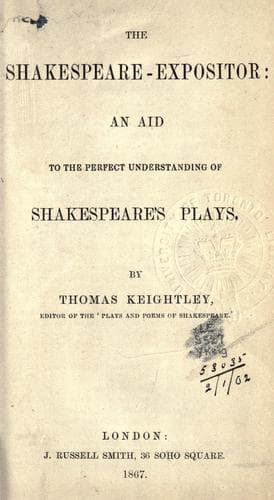
The Shakespeare-Expositor: An Aid to the Perfect Understanding of Shakespeare's PlaysKeightley, Thomas
General
The Shakespeare-Expositor: An Aid to the Perfect Understanding of Shakespeare's Plays
Keightley, Thomas
Drama -- Outlines, syllabi, etc.; Shakespeare, William, 1564-1616 -- Outlines, syllabi, etc.
* * * * *
"Why in this woolvish tongue should I stand here."
As, in Othello (i. 1), the folio reads "_tongued_ consuls" for "_toged_
consuls" of the 4to, editors here properly read _toge_ for 'tongue';
the 2nd folio has _gown_. As 'woolvish' offers very little sense, we
should, with Collier's folio, read _woolless_; for it has been already
(ii. 1) termed "the _napless_ vesture of humility."
* * * * *
"I have seen and heard of; for your voices _I_
Have done many things, some less, some more. Your voices."
* * * * *
"That our best water brought by conduits hither,
And nobly nam'd so, twïce being Censor."
That a line has been lost here is beyond doubt. Pope, who is generally
followed, added, "And Censorinus, darling of the people." But as the
words in North's Plutarch are "so surnamed because the people had
chosen him censor twice," it might be better to read "_And Censorinus,
he that was so nam'd_."
ACT III.
SC. 1. _Com._ "You are like to do such business."
With Malone I read _Cor._, to whom it is better suited. The names are
often given wrong in this play.
* * * * *
"Which we disdain'_d_ should tetter us."
* * * * *
"O good, but most unwise Patricians!"
The folio reads 'O God!' the judicious alteration is Theobald's, as
usual. See on Ham. ii. 2.
* * * * *
"They know the corn
Was not our recompense, resting well assured
They ne'er did service for 't."
For 'our' Southern read _their_, which seems to have been the poet's
word.
* * * * *
"Could never be the native
Of our so frank donation."
As I have never met with 'native' in the sense of origin, source, I
think, and so did Mason, that the right word is _motive_.
* * * * *
"How shall this bosom multiplied digest
The senate's courtesy."
I do not think that the text is, in any place in these plays, more
certainly correct than it is here; yet some late editors adopt without
hesitation _bisson multitude_, the reading of Collier's folio. By
'bosom multiplied' the poet means the union or complex of the bosoms,
_i.e._ hearts, affections, of the people. In his next speech Cor.
uses in a similar manner "multitudinous tongue;" and in ii. 2 we meet
"multiplying spawn." In Lear (v. 3) we have "the _common bosom_;" and
in our poet's Lover's Complaint "That he did in the _general bosom_
reign."
* * * * *
"To jump a body with a dangerous physic."
For 'Jump' Pope read _vamp_, Singer _imp_. 'Jump' is risk, hazard, and
the verb seems, like so many others, to be here causative.
* * * * *
"Go call the people; in whose name _I_ myself."
* * * * *
Public-domain text, read in full here on John Shaqi.
Reviews
Reviews
No reviews yet
Be the first to share your thoughts on this work.
Elsewhere in the archive
Join the Discussion
Join the discussion
Sign in to leave a comment or review.
Sign InorCreate an account