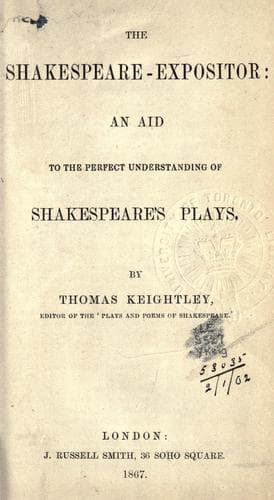
The Shakespeare-Expositor: An Aid to the Perfect Understanding of Shakespeare's PlaysKeightley, Thomas
General
The Shakespeare-Expositor: An Aid to the Perfect Understanding of Shakespeare's Plays
Keightley, Thomas
Drama -- Outlines, syllabi, etc.; Shakespeare, William, 1564-1616 -- Outlines, syllabi, etc.
There is, I think, either an aposiopesis at the end of the first line;
or a line is lost, as Volumnia is speaking quite calmly; or, _to
stoop_, _to yield_, or something of that sort is omitted.
* * * * *
"Before he should thus stoop to the heart."
Here again Theobald emended, _herd_ for 'heart.'
* * * * *
"You are too absolute;
Though therein you can never be too noble.
But when extremities speak ... I have heard you say."
So I think we should point to make sense.
* * * * *
"Nor by the matter which your heart prompts you _with_."
The metre requires a syllable; the 2nd folio reads _to_.
* * * * *
"But with such words that are but roated in."
'Roated' is probably _roted_; but no such verb occurs elsewhere as
_rote_. Boswell proposed _rooted_.
* * * * *
"Not _only_ what is dangerous present but
The loss of what is past."
There can be little doubt that _only_ was the word omitted.
* * * * *
"Often thus; which correcting thy stout heart,
Now humble as the ripest mulberry,
That will not hold the handling, [or] say to them."
By these slight corrections this place gains sense--a thing it never
had before. All through the speech, it may be observed, Volumnia acts
the part she would have her son perform. The transposition he had made
in the first line--where the folio has 'Which often thus'--having
perplexed the printer, he took 'humble' for a verb, and so introduced
'or' to try to make sense. (Introd. p. 67.) Mr. Dyce says "the passage
now stands as Shakespeare wrote it." Why, then, has he not given us the
sense of it?
* * * * *
"Even as she speaks, why _all_ their hearts were yours."
* * * * *
"Must I with my base tongue give to my noble heart."
It might be better to omit the first 'my' and 'to.'
* * * * *
"Well, mildly be it then; mildly _be it then_."
For an exactly similar effacement at the end of a scene see on Temp.
iii. 1.
* * * * *
SC. 3. "He has been used
Ever to conquer and to have his worth
Of contradiction."
I do not well understand 'worth' here. Rowe read _word_; but I cannot
approve of it; _wreak_ would seem better. We have "a heart of wreak"
(iv. 5); also Tit. And. iv. 3, 4. See on M. for M. ii. 1.
* * * * *
"Rather than envy _to_ you.--Well, well, no more."
* * * * *
"Given hostile strokes, and that not _only_ in the present."
* * * * *
"I have been consul, and can show from Rome
Her enemies' marks upon me."
The preposition should be _'fore_, _for_, or _to_.
Public-domain text, read in full here on John Shaqi.
Reviews
Reviews
No reviews yet
Be the first to share your thoughts on this work.
Elsewhere in the archive
Join the Discussion
Join the discussion
Sign in to leave a comment or review.
Sign InorCreate an account