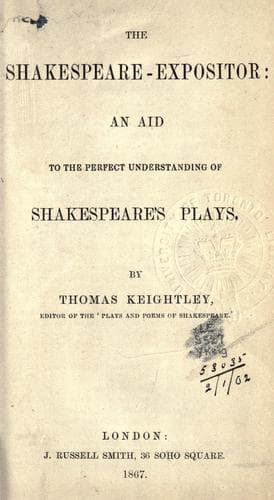
The Shakespeare-Expositor: An Aid to the Perfect Understanding of Shakespeare's PlaysKeightley, Thomas
General
The Shakespeare-Expositor: An Aid to the Perfect Understanding of Shakespeare's Plays
Keightley, Thomas
Drama -- Outlines, syllabi, etc.; Shakespeare, William, 1564-1616 -- Outlines, syllabi, etc.
A line is apparently lost here; or there is an aposiopesis.
* * * * *
"Like a bold flood o'erbear _her_. O! come, go in."
* * * * *
"To fright 'em ere destroy _'em_. But come in."
* * * * *
"This peace is _good for_ nothing but to rust iron."
Steevens, without being aware of the metric requirement, made the same
addition.
* * * * *
"than War's a destroyer of men.--'Tis so, and as
War[s] in some sort may be said to be a ravisher," etc.
* * * * *
SC. 6. "If he had gone forth Consul, _have_ found it so."
* * * * *
"And who resist
Are mocked for _their_ valiant ignorance."
* * * * *
SC. 7. "Which he was lord of; or whether nature _in him_."
* * * * *
"And Power, unto itself most commendable,
Hath not a tomb so evident as a chair
To extol what it hath done."
I agree with Steevens in regarding this passage and the comments on
it as being equally unintelligible. The meaning seems to be one which
Shakespeare frequently expresses (see Tr. and Cr. i. 3, ii. 3, iii.
3)--self-praise is no praise. 'Unto itself commendable' is, then,
standing high in the possessor's estimation. The sense yielded by
'tomb' and 'chair' is most trivial, and I would therefore venture to
propose
"Hath not a tongue so evident as a charmer's."
Charms and spells, we know, were murmured or muttered in a low tone
("wizards that peep and that mutter" Is. viii. 19); and if the final
letters of _charmer's_ had been effaced--like _in him_ a few lines
higher--and only _char_ left, the printer might easily have taken it
for 'chair,' and so have made 'tomb' to correspond. For 'chair' Singer
reads _hair_; Collier's folio _cheer_. _Charmer_ occurs in Oth. iii. 4,
and the poet had met with it in his Bible. I have introduced it again
in Ant. and Cl. iv. 8.
* * * * *
"One fire drives out one fire; one nail one nail;
Rights by rights fouler, strengths by strengths do fail."
For 'fouler' Dyce reads _faulter_, Singer _foil'd are_. We might also
conjecture _fall, and_; the final _d_ in this last not being sounded.
_Fall_ and _fail_ come thus together in "Fall Greeks, fail fame;
honour or go or stay" (Tr. and Cr. v. 1). It seems, however, safest to
read, with Malone, as I have done, _founder_. We have "All his tricks
_founder_" (H. VIII. iii. 2). What is said of fire in the first line is
a favourite idea with our poet. We have it again in Two Gent. ii. 4, K.
John, iii. 1. It is an allusion to the homoeopathic mode of curing a
burn by holding it to the fire. By the fires, etc., he means Coriolanus
and himself.
ACT V.
SC. 1. "It was a bare petition of a State
To one whom they had punish'd."
Public-domain text, read in full here on John Shaqi.
Reviews
Reviews
No reviews yet
Be the first to share your thoughts on this work.
Elsewhere in the archive
Join the Discussion
Join the discussion
Sign in to leave a comment or review.
Sign InorCreate an account